
 Contatto
 Come acquistare
Consegna
Guida all'acquisto
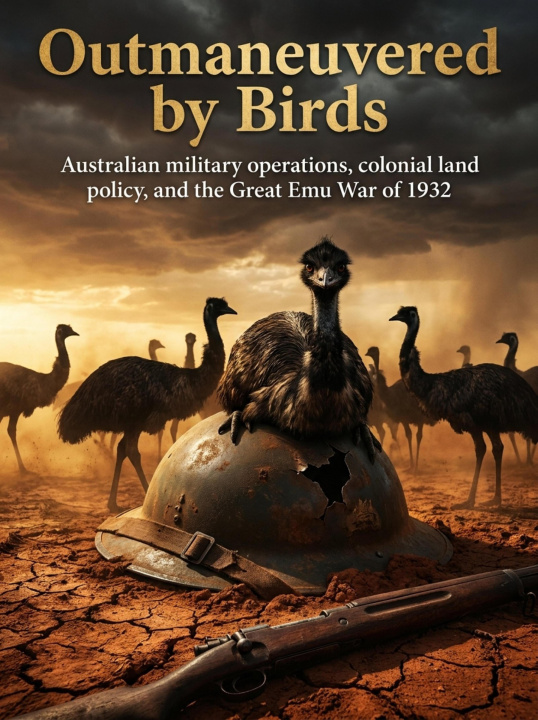
Outmaneuvered by Birds
Australian military operations, colonial land policy, and the Great Emu War of 1932
 Inglese
 22 b
22 b
 Nuovi
Nuovi

In November 1932, the Australian Army deployed Lewis guns against twenty thousand emus advancing across the wheat fields of Western Australia - and lost. What should have been a minor pest-control operation became a parliamentary embarrassment, a logistical failure studied in military schools, and an unlikely lens through which to examine how postwar Australia governed its land, its veterans, and its national self-image. The campaign had been framed as practical relief: ex-soldiers from the Great War were farming marginal land under government resettlement schemes, and the annual emu migration threatened their already fragile harvests. When Major G.P.W. Meredith of the Royal Australian Artillery arrived with two Lewis guns and ten thousand rounds, the assumption was that military discipline would prevail over instinct. It did not. The emus absorbed gunfire, scattered into smaller units, and rendered concentrated fire ineffective. Within a week, the operation was suspended under public ridicule. What this episode reveals is not simply comedic incompetence, but a deeper institutional tension: a settler state deploying its military apparatus against a landscape it could never fully control, exposing the limits of bureaucratic confidence in environments shaped by forces older than the nation itself. Across three phases of the campaign, this book traces the decision chain from Canberra to the Campion district, the political fallout in the press, and what the 1932 operation tells us about the colonial logic embedded in Australian land management that persists long after the emus won.


Informazioni sul libro
Inglese

Regala questo libro oggi stesso
È facile
1 Aggiungi il libro al carrello e scegli la consegna come regalo 2 Ti invieremo subito il buono 3 Il libro arriverà all'indirizzo del destinatarioCiao! Sono Libroamiko, il tuo consulente di libri.
Come posso aiutarti?