
 Contatto
 Come acquistare
Consegna
Guida all'acquisto
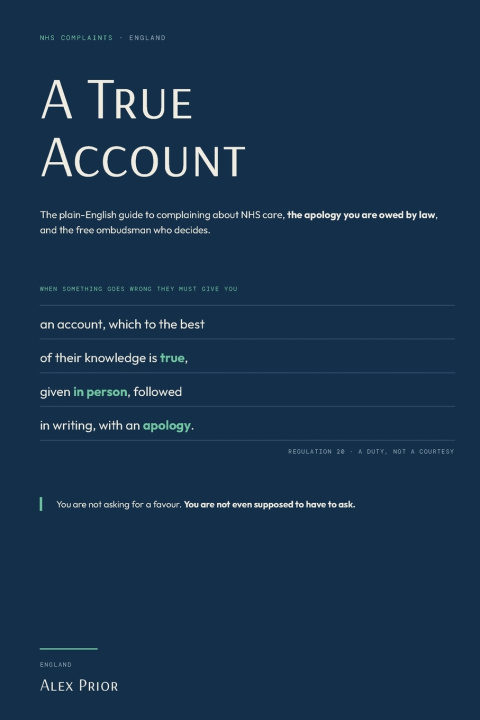
A True Account
The Plain-English Guide to Complaining About NHS Care, the Apology You Are Owed by Law, and the Free Ombudsman Who Decides
 Inglese
 29 b
29 b
 In preparazione
 Nuovi
Nuovi
Fino a 30 giorni per il reso

You are not supposed to have to ask for the truth.
Something went wrong with your care, or your mother's, and nobody has explained it. You are probably about to write a polite letter asking whether somebody might be able to tell you what happened.
Do not send it yet.
Regulation 20 of the Health and Social Care Act 2008 (Regulated Activities) Regulations 2014 already requires them to tell you. When a notifiable safety incident occurs the provider must notify you, do it in person, give "an account, which to the best of the health service body's knowledge is true", give "an apology", provide reasonable support, and follow all of it with a written notification.
It is called the duty of candour. It is a legal duty, not a courtesy, and almost nobody has heard of it. So families ask, carefully, for information the NHS was already obliged to volunteer, and feel grateful when a fraction of it arrives.
This book prints what the law actually says, with the provision number attached:
- that a notifiable safety incident includes prolonged psychological harm, meaning harm lasting or likely to last at least 28 continuous days;
- that the time limit is twelve months under regulation 12, that it runs from when the matter "came to the notice of the complainant" if that is later, and that it can be extended;
- that you must be acknowledged within three working days under regulation 13, and offered a discussion about how the complaint will be handled;
- that under regulation 14(2) a response must contain "the conclusions reached" and details of your right to go to the Ombudsman, so three pages of process and no finding does not comply;
- that the Parliamentary and Health Service Ombudsman is free, is independent, and that for health complaints you go direct, without an MP;
- and that a bereaved family member can complain in their own right under section 9 of the Health Service Commissioners Act 1993.
Then it does the work. What to send today when nobody has said anything. How to get the records. What to ask in the meeting, and who to take with you. How to read a response that says a great deal and concludes nothing. How to test the sentence "lessons have been learned". What a real apology looks like, and what the other kind looks like. How to refer to the Ombudsman, what to send, and what happens if the answer is no.
And the free advocate almost nobody uses. Independent NHS Complaints Advocacy is statutory, free and independent of the NHS. They will help you write it, come to the meeting with you, and do the Ombudsman referral. Nobody should ever be paying for this.
Every letter you need is written out to copy, with worksheets for the complaint, the chronology, the meeting, checking the response against regulation 14(2), and the referral.
It is honest about the limits. Most complaints are not upheld. The Ombudsman's financial remedies are modest and this is not a route to compensation. A complaint is not a claim, and if a claim matters to you the three-year limitation period is shorter than it sounds. There is a chapter on what is simply not true, including the widespread belief that you must go through your MP, that the NHS cannot apologise, and that there is a six-month deadline.
England only. Wales, Scotland and Northern Ireland run separate systems with separate ombudsmen.
Information, not legal or medical advice. Current as of August 2026.


Informazioni sul libro
Inglese
Categorie
