
 Contatto
 Come acquistare
Consegna
Guida all'acquisto
Acehnology
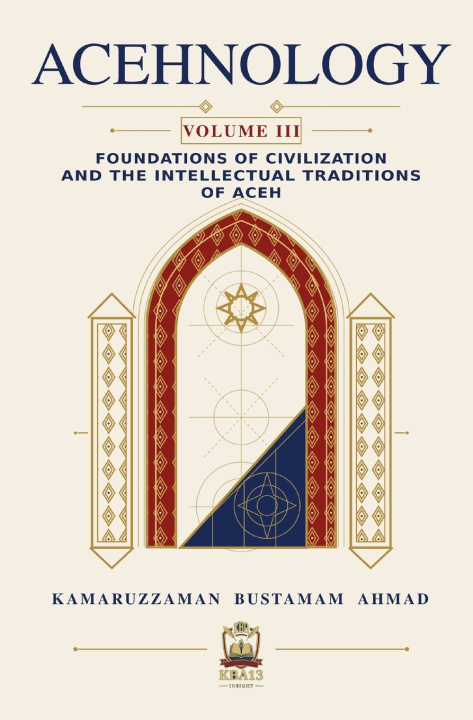
Volume III: Foundations of Civilization and the Intellectual Traditions of Aceh
 Inglese
 59 b
59 b
 In preparazione
 Nuovi
Nuovi
Fino a 30 giorni per il reso

What sustains a civilization-and what happens when a society loses contact with its intellectual foundations?
Acehnology, Volume III: Foundations of Civilization and the Intellectual Traditions of Aceh examines the cultural, linguistic, spiritual, and scholarly forces that have shaped Acehnese civilization. Continuing the interdisciplinary project developed in the preceding volumes, Kamaruzzaman Bustamam Ahmad explores how Aceh has understood itself, transmitted knowledge, and maintained its intellectual identity across generations.
The book begins with the civilizational foundations of Acehnology. It investigates the relationship between consciousness, collective spirit, cosmology, culture, and the formation of an Acehnese worldview. Civilization is approached not only through political power or material achievement, but also through a society's understanding of existence, morality, language, knowledge, and its place within the universe.
Aceh once occupied an influential position in the history of Islam, maritime Southeast Asia, and the wider Malay world. Its scholars, rulers, religious institutions, literary traditions, and international networks helped establish an important centre of Islamic civilization. Yet this intellectual inheritance has been disrupted by colonialism, conflict, political change, and the weakening of local systems of knowledge. This volume asks what remains of the Acehnese civilizational spirit and how its traces survive in culture, language, education, and religious life.
The book gives particular attention to the Acehnese cultural system and its distinctive vocabulary. Concepts such as lon, na, and reusam are treated as keys to understanding selfhood, existence, action, social relations, and collective identity. The Acehnese language is examined as a carrier of cultural memory and religious meaning. Its declining public role raises an urgent question: can a civilization preserve its identity when its language is no longer a major medium of scholarship and cultural production?
The second part investigates Acehnese modes of thought, scholarly apprenticeship, authorship, overseas education, Islamic schools, and religious authority. It examines meudagang-the journey undertaken by students in search of religious knowledge-and the relationship between teachers, students, spirituality, and intellectual formation. These traditions are connected with Hamzah Fansuri and the history of Acehnese Islamic scholarship.
The volume also asks why Acehnese ulama wrote, how manuscripts preserved knowledge, and how networks extending to the Ḥaramayn shaped Aceh's intellectual history. The contribution of overseas-educated scholars is considered alongside the expansion of international education after the 2004 Indian Ocean tsunami.
The final chapters examine the future of the dayah, Aceh's traditional Islamic educational institution. They explore how the dayah reproduces knowledge, spirituality, discipline, and social leadership while facing modernization, technology, institutional competition, and changing expectations. The transition from the traditional authority of the teungku to the growing prominence of the ustaz reveals a broader transformation in religious authority and Islamic identity in contemporary Indonesia.
Bringing together Aceh history, cultural anthropology, Islamic education, sociology of religion, indigenous knowledge, language, and Southeast Asian studies, Volume III presents civilization as a living structure sustained by teachers, institutions, books, memories, and inherited ways of thinking.
Written for scholars, students, researchers, and serious readers, this volume grounds Acehnology in the language, civilizational memory, intellectual practices, educational institutions, and living traditions through which Acehnese people have understood their world.


Informazioni sul libro
Inglese
