
 Contatto
 Come acquistare

Consegna
Guida all'acquisto
 Inglese
 86 b
 Nuovi
 Consegniamo entro Natale ▾
Magazzino esterno
Inviamo tra 9-13 giorni
Fino a 30 giorni per il reso

Your actuator can meet every datasheet specification-and still fail in the machine.
The motor has enough torque. The cylinder delivers the specified force. The controller looks perfect on paper.
Then the real system starts moving. The load oscillates. The gearbox introduces backlash. The windings overheat. Position accuracy disappears under force. Or the actuator works beautifully for thirty seconds-but cannot survive its actual duty cycle.
The problem isn't necessarily the component. It's the engineering between the specification and the finished machine.
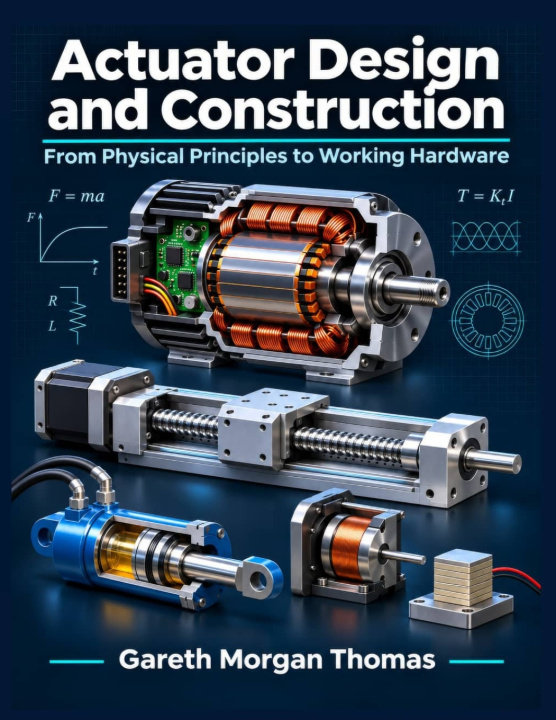
ACTUATOR DESIGN AND CONSTRUCTION closes that gap.
From Physical Principles to Working Hardware is a comprehensive engineering guide to selecting, sizing, designing, constructing, controlling, and testing the devices that turn energy into useful mechanical motion.
Instead of treating motors, transmissions, electronics, sensors, and loads as unrelated parts, this book shows you how they interact as one physical system-and how to make design decisions that stand up to measurement.
WHAT YOU'LL LEARN TO DESIGN, BUILD, AND VERIFYSelect the right actuator technology by comparing force, torque, stroke, speed, stiffness, bandwidth, efficiency, and duty cycle-not marketing claims.
Calculate loads, reflected inertia, gear ratios, screw-drive forces, mechanical resonance, and the margins that separate a sound design from an expensive mistake.
Understand brushed, brushless, stepper, and direct-drive motors-including custom winding and assembly-alongside solenoids, voice coils, and linear motors.
Engineer transmissions, gear trains, screw drives, low-backlash mechanisms, and compliant robotic joints.
Work with pneumatic and hydraulic cylinders, valves, power units, soft actuators, and fluid-power control.
Explore piezoelectric devices, shape-memory alloys, electroactive polymers, magnetostrictive systems, and MEMS actuation.
Integrate position, force, torque, current, and temperature sensing with drive electronics and feedback control.
Address the problems that destroy real hardware: heat, friction, misalignment, vibration, insulation failure, leakage, and fatigue.
Build test rigs, measure actual performance, investigate failures, and document the operating limits of your design.
The final project chapter moves beyond theory with six practical builds: a scratch-built solenoid, a stepper-and-lead-screw linear actuator, a voice-coil positioner, a quasi-direct-drive robot joint, a shape-memory gripper, and a pneumatic soft actuator. Failed-build lessons show where assumptions break down-and what to check before repeating the mistake.
This is not a collection of disconnected motor descriptions. It follows the whole engineering chain: physical principles, requirements, calculations, materials, fabrication, assembly, electronics, control, thermal design, and experimental verification.
Written for roboticists, mechanical and electrical engineers, mechatronics students, automation designers, researchers, and serious builders who need working hardware-not another attractive concept diagram.
If you're building a robot joint, precision positioner, industrial mechanism, custom motor, or fluid-powered machine, your results will depend on decisions made long before the first test. Make those decisions with the physics, methods, and practical examples in hand.
ACTUATOR DESIGN AND CONSTRUCTION
From Physical Principles to Working Hardware
Stop guessing at what should work. Learn to engineer what does.


Informazioni sul libro
Inglese
Categorie

Regala questo libro oggi stesso
È facile
1 Aggiungi il libro al carrello e scegli la consegna come regalo 2 Ti invieremo subito il buono 3 Il libro arriverà all'indirizzo del destinatarioCiao! Sono Libroamiko, il tuo consulente di libri.
Come posso aiutarti?