
 Contatto
 Come acquistare

Consegna
Guida all'acquisto
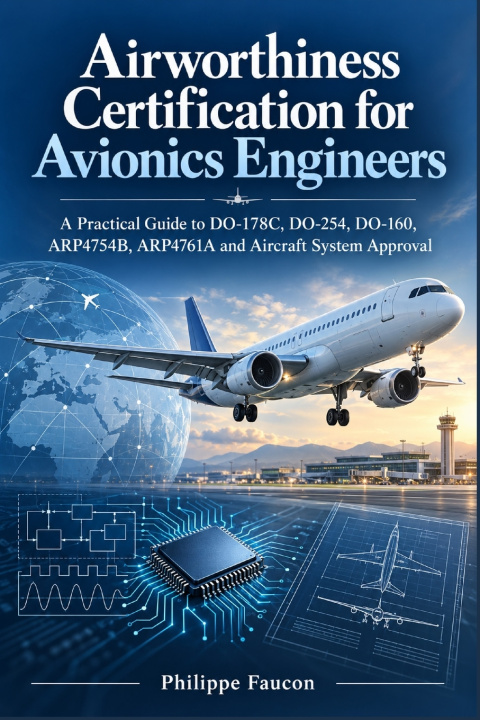
Airworthiness Certification for Avionics Engineers
A Practical Guide to DO-178C, DO-254, DO-160, ARP4754B, ARP4761A and Aircraft System Approval
 Inglese
 57 b
 Nuovi
Fino a 30 giorni per il reso

Your avionics hardware works. Your software passes every test. But is your equipment ready for aircraft certification?
Developing electronic equipment for aviation requires more than reliable circuits, functional software, and successful laboratory testing. Engineers must also understand safety assessments, development assurance levels, requirements traceability, independent verification, environmental qualification, and the evidence needed to support airworthiness approval.
Airworthiness Certification for Avionics Engineers bridges the gap between conventional electronics development and the rigorous processes expected in civil aviation.
Written for practicing engineers rather than certification specialists, this book explains how the major aviation standards fit together-and, more importantly, how they change everyday engineering decisions.
Inside This BookFAA and EASA approval: Development assurance, TSO/ETSO authorization, production conformity, and aircraft installation approval.
ARP4754B and ARP4761A: System requirements, safety assessments, failure analysis, and development assurance levels.
DO-254: FPGA and electronic hardware development, requirements-based verification, design reviews, and traceability.
DO-178C: Software lifecycle objectives, structural coverage, MC/DC, independent verification, and problem reporting.
DO-160: Environmental qualification, test categories, and equipment installation considerations.
Avionics networks: ARINC 429, MIL-STD-1553B, AFDX, Ethernet, redundancy, latency, and fault containment.
Certification evidence: Verification reports, configuration baselines, conformity, review findings, and change-impact assessments.
Project management: Development plans, supplier management, reusable designs, engineering responsibilities, and certification deliverables.
Follow the development of an airborne Ethernet communication module containing an FPGA, microcontroller, dual Ethernet channels, and a configuration database.
Realistic requirements, Verilog and C examples, fault analyses, verification procedures, and evidence checklists demonstrate how an ordinary electronic design becomes a certification-oriented engineering project.
Who Should Read This Book?Designed for electronics engineers, FPGA designers, embedded software developers, verification engineers, systems engineers, and technical project managers entering or working in the aerospace industry.
No previous certification experience is required, but a basic understanding of electronics or software development is assumed.
With eleven chapters, a practical case study, an acronym glossary, and certification evidence reference tables, this book provides the engineering foundation needed to understand and participate in airborne equipment development and approval.
Learn not only how to build avionics that work, but how to demonstrate that the design satisfies its requirements through controlled, verifiable engineering evidence.
By Philippe Faucon, author of Mastering ARINC 429, Understanding MIL-STD-1553B, and Mastering AFDX / ARINC 664 Part 7.


Informazioni sul libro
Inglese

Regala questo libro oggi stesso
È facile
1 Aggiungi il libro al carrello e scegli la consegna come regalo 2 Ti invieremo subito il buono 3 Il libro arriverà all'indirizzo del destinatarioCiao! Sono Libroamiko, il tuo consulente di libri.
Come posso aiutarti?