
 Contatto
 Come acquistare
Consegna
Guida all'acquisto
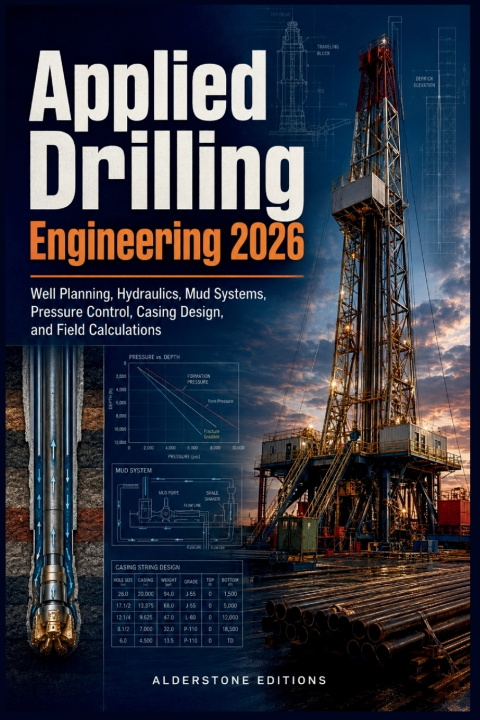
Applied Drilling Engineering 2026
Well Planning, Hydraulics, Mud Systems, Pressure Control, Casing Design, and Field Calculations
 Inglese
 342 b
342 b
 In preparazione
 Nuovi
Nuovi
Fino a 30 giorni per il reso

A drilling program can look complete on paper and still fail in the field because one pressure estimate was wrong, one mud window was too narrow, one casing seat was poorly chosen, or one hydraulic assumption was never checked.
Applied Drilling Engineering 2026 is a practical engineering reference for students, drilling and well engineers, wellsite personnel, supervisors, and early-career oil and gas professionals who need to plan, calculate, and execute safer, more efficient wells.
Built around the full well-construction lifecycle, this book connects theory with field application. It explains how formation data, pressure behavior, mud properties, hydraulics, casing design, well control, and operational constraints interact during real drilling decisions.
Inside, you will learn:
• Well planning, rig systems, well types, trajectories, and the complete well-construction lifecycle
• Formation properties, rock mechanics, in-situ stresses, pore pressure, fracture pressure, and drilling-window concepts
• Pore-pressure prediction using seismic velocity, d-exponent, drilling indicators, and wireline logs
• Fracture-gradient estimation using Matthews & Kelly, Eaton, and Daines methods
• LOT, FIT, and XLOT interpretation, casing-seat selection, and kick-tolerance fundamentals
• Mud systems including WBM, OBM, and SBM, with rheology, filtration, additives, solids control, and conditioning
• Drilling hydraulics, pipe and annular pressure losses, bit hydraulics, ECD, and circulation-system optimization
• Hole cleaning, annular velocity, cuttings transport, and challenges in deviated and horizontal wells
• Pressure control, well integrity, and practical well-control considerations
• Casing design, directional drilling, field calculations, and integrated well design
• Worked examples, exercises, terminology checks, and practical calculations in SI and common oilfield units
• Standards-aware guidance referencing API, ISO, NORSOK, SPE, and applicable regulatory frameworks
Rather than presenting formulas without context, the book consistently links calculations to the engineering decision they support: Is the mud weight adequate? Is the fracture margin safe? Can the planned flow rate clean the hole without excessive ECD? Is the casing seat deep enough? What data should be checked before changing the well program?
The content progresses through 16 units, beginning with drilling fundamentals and formation behavior, then moving through fluids, hydraulics, pressure control, casing design, risk, cost, execution planning, and emerging technologies.
Whether you are studying petroleum engineering, preparing for field responsibilities, reviewing a well program, or strengthening your drilling calculations, Applied Drilling Engineering 2026 provides a structured reference for making better technical decisions from planning through well delivery.
Plan the well. Control the pressure. Verify the calculations. Drill with confidence.


Informazioni sul libro
Inglese
Categorie

Regala questo libro oggi stesso
È facile
1 Aggiungi il libro al carrello e scegli la consegna come regalo 2 Ti invieremo subito il buono 3 Il libro arriverà all'indirizzo del destinatarioCiao! Sono Libroamiko, il tuo consulente di libri.
Come posso aiutarti?