
 Contatto
 Come acquistare
Consegna
Guida all'acquisto
 Inglese
 49 b
49 b
 In preparazione
 Nuovi
Nuovi
Fino a 30 giorni per il reso

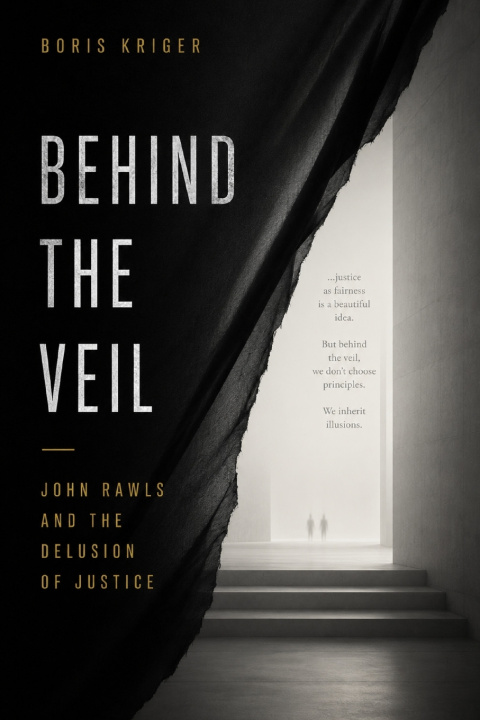
You are about to be born, and you get to write the rules first. There is one catch: you do not know who you will be. Not your family, not your country, not your talents, not your health, not your century. Whatever you write will land on you with the full weight of a life. What do you write?
That question, in its modern form, belongs to John Rawls - a shy man in Massachusetts who stammered, refused nearly every interview, would not permit his photograph on the jacket of his own books, and then quietly rearranged the way an entire language argues about fairness. A Theory of Justice appeared in 1971 after twenty years of rewriting. Within a decade, almost every serious argument in English-language political philosophy was being conducted either from inside his framework or in flight from it. Even the people who hated the book had to learn its vocabulary in order to attack it, which is one working definition of victory.
This book takes Rawls seriously enough to find the flaw that his admirers and his critics both walked past. It is not the veil of ignorance, which is a perfectly respectable piece of philosophical machinery. It is a single quiet sentence, early on, in which Rawls stipulates that the people behind the veil are mutually disinterested - that they take no interest in one another's interests. Nobody objected. It looked modest. It was not modest. It deleted, in one line, the strongest disposition the human animal has.
Because we now know things Rawls could not have known in 1971. That trust and generosity run on measurable chemistry, and that the body rewards giving the way it rewards food. That paying people for blood produces less blood, and worse. That fining parents for arriving late makes them later, permanently. That care given by choice lowers the giver's stress hormones while the same care given under obligation shortens the giver's chromosomes. That in peer systems sharing an environment, cooperation is not the assumption but the result - and it is the fighting that requires an explanation.
Drawing on formal work in complex systems, on the neurochemistry of trust, on the collapse of the Hobbesian premise Rawls inherited without examining, and on nine years spent running a shelter community that had no rules and needed none, this book asks what the argument for justice looks like if you put back what was assumed away. The two principles survive the operation. The device that generated them does not survive unchanged. And the priority Rawls gave to liberty turns out to be right for a reason he never had available to him.
KEYWORDS Justice, Rawls, Cooperation, Fairness, Altruism, Philosophy, Society


Informazioni sul libro
Inglese

Regala questo libro oggi stesso
È facile
1 Aggiungi il libro al carrello e scegli la consegna come regalo 2 Ti invieremo subito il buono 3 Il libro arriverà all'indirizzo del destinatarioCiao! Sono Libroamiko, il tuo consulente di libri.
Come posso aiutarti?