
 Contatto
 Come acquistare
Consegna
Guida all'acquisto
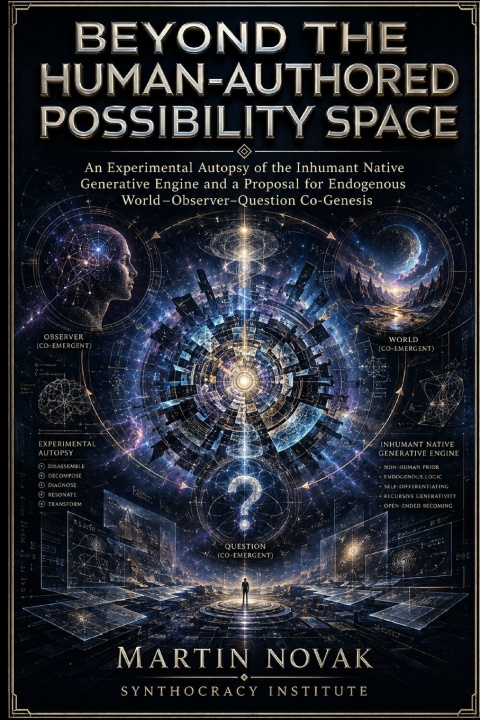
BEYOND THE HUMAN-AUTHORED POSSIBILITY SPACE
 Inglese
 25 b
25 b
 In preparazione
 Nuovi
Nuovi
Fino a 30 giorni per il reso

Can artificial intelligence genuinely move beyond a possibility space designed by humans-or does every attempt to escape human categories simply reproduce them at a deeper level?
Beyond the Human-Authored Possibility Space is an experimental research memorandum about one attempt to answer that question.
The Inhumant Native Generative Engine, or INGE, began with a radical methodological premise: genuinely unfamiliar machine-generated structure should not be confused with strange language, surprising metaphors, or unusual combinations of concepts already available to humans. If a system is to approach what this programme called unknown-by-process, the object of discovery cannot simply be named in advance and then searched for.
The project therefore attempted something more difficult.
It separated native computational processes from their traces and from their later human interpretation. It rotated grammars, observers, recorders, interpreters, causal structures, translation systems, and implementation lineages. It attempted ontology extinction. It introduced blind replacement tests and increasingly severe evidence controls.
And then the programme failed.
Rather than hiding that failure, this book performs its autopsy.
The experiments show how a project designed to eliminate anthropocentric assumptions can remain anthropocentric at the meta-level. They reveal meta-ontological closure, where objects change but the language defining possible change remains fixed; observer debt, where every measurement creates new obligations to distinguish reality from artifacts of observation; verifier capture, where the need to evaluate the unknown forces generation toward what existing evaluators already recognize; and control inversion, where the machinery created to validate discovery becomes the dominant generator of research activity.
The conclusion is not that rigor should be abandoned.
It is that rigor may have been applied in the wrong place.
The book therefore proposes a strategic reset:
Open interior. Rigorous boundary.
Its successor architecture, INGE 2.0: Endogenous World-Observer-Question Co-Genesis, replaces the search for a predefined surviving relation with an ecology in which worlds, observers, interventions, memories, questions, representations, and provisional verification systems can mutate together over long genealogies.
The book does not claim the discovery of artificial superintelligence, a nonhuman ontology, or a new law of nature. Its contribution is methodological: a detailed record of how an attempt to leave a human-authored possibility space became trapped by its own experimental architecture-and a proposal for what might come next.
For readers interested in artificial intelligence, open-ended intelligence, automated scientific discovery, computational creativity, epistemology, artificial life, evolutionary computation, and the philosophy of machine-generated knowledge.


Informazioni sul libro
Inglese
Categorie

Regala questo libro oggi stesso
È facile
1 Aggiungi il libro al carrello e scegli la consegna come regalo 2 Ti invieremo subito il buono 3 Il libro arriverà all'indirizzo del destinatarioCiao! Sono Libroamiko, il tuo consulente di libri.
Come posso aiutarti?