
 Contatto
 Come acquistare
Consegna
Guida all'acquisto
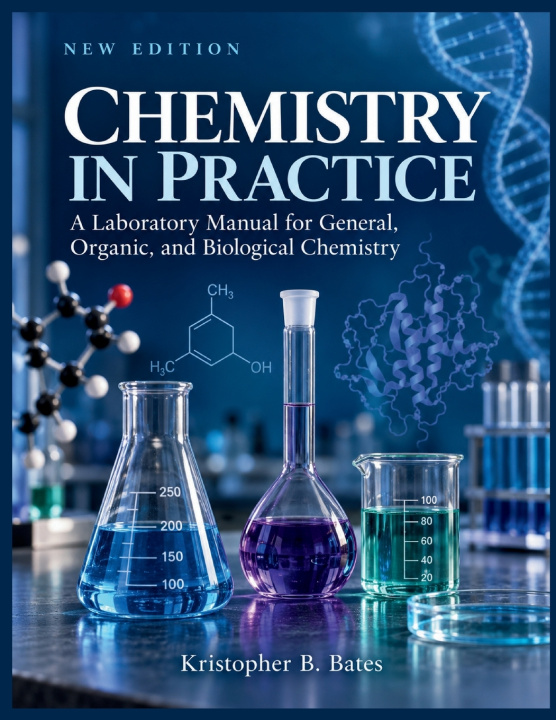
CHEMISTRY IN PRACTICE
A Laboratory Manual for General, Organic, and Biological Chemistry
 Inglese
 198 b
198 b
 Nuovi
Nuovi
Fino a 30 giorni per il reso

A student who finishes a general chemistry titration is often told, a semester later, to perform an organic extraction, and a semester after that, to run a biochemical enzyme assay, with little ever connecting the three.
Many chemistry laboratory sequences are assembled from separate sources for each branch of the subject, general, organic, and biological, so students are left to rebuild their understanding of laboratory technique, safety practice, and data analysis at every transition. Measurement habits, significant-figure reporting, and basic safety protocol are often taught once and then simply assumed later, with little explanation of how they are meant to carry forward.
This laboratory manual treats laboratory skill as continuous rather than divided by subject. It sequences thirty-five complete experiments across three connected parts, general chemistry, organic chemistry, and biological chemistry, so that a technique introduced early, such as measurement and significant figures, or a principle such as partitioning between two phases, is referenced and extended rather than retaught each time it reappears.
- Work through a single, unified progression of experiments instead of reconciling separate manuals for each branch of chemistry.
- Build laboratory safety habits from the first chapter, using a complete framework covering hazard communication, safety data sheets, and standard hazard-rating systems, before working with any reagent.
- Learn measurement, significant figures, error analysis, and graphing conventions once, in a dedicated early chapter, then apply that same approach consistently across every experiment that follows.
- Perform quantitative experiments in stoichiometry, gas laws, solution concentration, acid-base chemistry, thermochemistry, equilibrium, and electrochemistry, each with full data tables and guided calculations.
- Apply core organic techniques, including melting-point and boiling-point determination, liquid-liquid extraction, recrystallization, distillation, and thin-layer chromatography, to genuine purification and identification problems.
- Identify carbohydrates, lipids, proteins, and nucleic acids using established biochemical testing methods, and examine enzyme activity, buffer behavior, and metabolic modeling in a biological context, connecting each result back to earlier chapters.
- Use a built-in report checklist and a set of post-laboratory discussion questions with every experiment, so that data, calculations, and the underlying chemistry are tied together before moving on.
Laboratory safety and hazard communication, measurement and data analysis, atomic structure, stoichiometry, gas laws, solutions and concentration, acid-base chemistry and pH, thermochemistry, equilibrium, oxidation-reduction reactions, organic functional groups, extraction and purification techniques, chromatography, reactivity of major organic compound classes, and identification of carbohydrates, lipids, proteins, and nucleic acids, plus reference appendices and a glossary.
Written for students working through a combined general, organic, and biological chemistry laboratory sequence, including those preparing for nursing, allied-health, nutrition, and related science programs, as well as instructors and departments seeking one consistent framework across all three parts. It is intended for use in a supervised, properly equipped laboratory under a qualified instructor, not for unsupervised experimentation at home.
Take the next step toward a clearer, more connected understanding of an entire chemistry laboratory sequence: get your copy and start exploring the experiments, techniques, and reference material inside.


Informazioni sul libro
Inglese
Categorie

Regala questo libro oggi stesso
È facile
1 Aggiungi il libro al carrello e scegli la consegna come regalo 2 Ti invieremo subito il buono 3 Il libro arriverà all'indirizzo del destinatarioCiao! Sono Libroamiko, il tuo consulente di libri.
Come posso aiutarti?