
 Contatto
 Come acquistare
Consegna
Guida all'acquisto
 Inglese
 62 b
62 b
 In preparazione
 Nuovi
Nuovi
Fino a 30 giorni per il reso

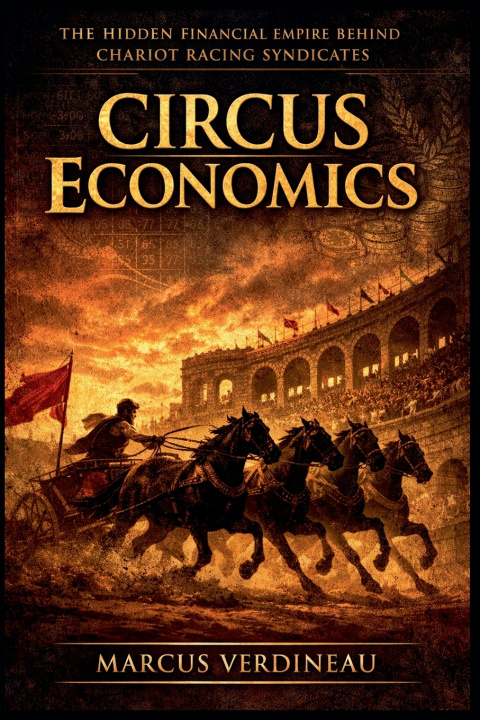
Rome did not run on glory alone. It ran on money, and nowhere was that money more ruthlessly organized than inside the roaring bowl of the Circus Maximus.
Two hundred and fifty thousand spectators packed those stands on race day, more people than most ancient cities held in total. They came to watch four factions, the Reds, Whites, Blues, and Greens, hurl chariots around a stone spine at breakable speed. What they rarely saw was the empire behind the spectacle: stable syndicates that bred and traded horses worth more than senatorial estates, betting networks that moved currency across provinces faster than the imperial post, and charioteers who began as slaves and retired as some of the wealthiest free men in the ancient world.
Circus Economics pulls back the curtain on this hidden machine. It follows the money from the breeding farms of Hispania and North Africa, where horses were selected with the same cold calculation modern scouts apply to draft picks, through training compounds where a single promising colt could bankrupt a rival faction if it changed hands, into counting rooms where faction managers balanced books that would not look out of place in a modern trading house. It traces how a driver like Gaius Appuleius Diocles walked away from the track having earned, by some estimates, a fortune equivalent to the treasury of a small province, and how the syndicates behind him functioned less like sports clubs and more like multinational holding companies with political influence stretching into the Senate itself.
This is a book about incentives as much as chariots. Why did emperors pour public funds into races that cost more than aqueducts? Why did faction loyalty split the city along lines as sharp as any political party? Who actually profited when a driver died in a crash before eighty thousand cheering fans? The answers reveal a Roman economy far more sophisticated, and far more familiar, than the marble and myth usually let on. Sponsorship deals, celebrity endorsement, insider trading on race outcomes, and labor markets for enslaved athletes all existed in some form nearly two thousand years before anyone coined the term sports business.
Drawing on inscriptions, legal texts, satirical poetry, and the account records that survived by accident rather than design, this book reconstructs a financial world that has been hiding in plain sight for centuries, disguised as mere entertainment. Readers of ancient history will find a fresh lens on daily Roman life. Readers of business and economic history will recognize patterns that never really left us: monopoly formation, athlete valuation, public subsidy of private spectacle, and the quiet power of those who control the odds.
Circus Economics is not another retelling of gladiators and emperors. It is the story of the accountants, breeders, bookmakers, and stable owners who understood something the crowd never did, that the real race was for the money, and it never stopped.


Informazioni sul libro
Inglese

Regala questo libro oggi stesso
È facile
1 Aggiungi il libro al carrello e scegli la consegna come regalo 2 Ti invieremo subito il buono 3 Il libro arriverà all'indirizzo del destinatarioCiao! Sono Libroamiko, il tuo consulente di libri.
Come posso aiutarti?