
 Contatto
 Come acquistare
Consegna
Guida all'acquisto
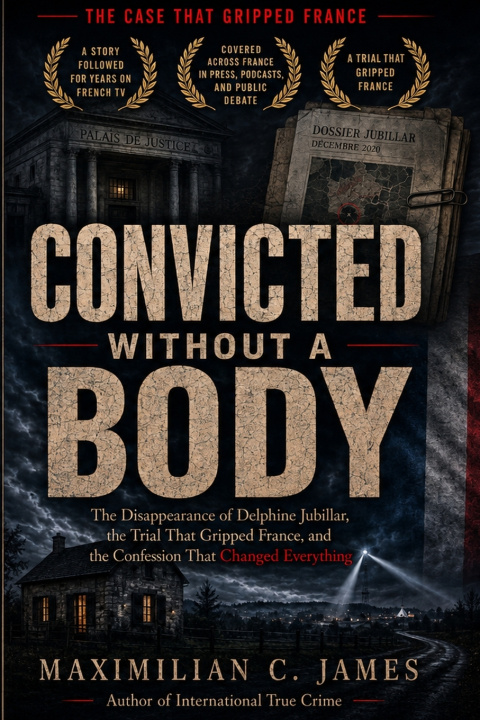
CONVICTED WITHOUT A BODY
The Disappearance of Delphine Jubillar, the Trial That Gripped France, and the Confession That Changed Everything
 Inglese
 35 b
35 b
 In preparazione
 Nuovi
Nuovi
Fino a 30 giorni per il reso

A woman vanished. There was no body, no confirmed crime scene, and no confession. Yet five years later, her husband was convicted of murder. Then the case changed again.
In December 2020, Delphine Jubillar, a 33-year-old nurse and mother of two, disappeared from her home in Cagnac-les-Mines in southern France. Her disappearance became one of the most closely followed true crime cases in modern France, dominating television coverage, newspapers, podcasts and public debate.
Attention soon turned to her husband, Cédric Jubillar.
But investigators faced an extraordinary problem: how do you prove a murder when there is no body?
For years, police searched the countryside, analysed mobile-phone records, examined the family home, questioned neighbours, reconstructed vehicle movements and tested conflicting witness accounts. Cédric Jubillar repeatedly denied killing his wife.
Then, in October 2025, a French court convicted him of Delphine's murder and sentenced him to thirty years in prison - even though her body had never been recovered.
The verdict should have been the climax of the case.
It wasn't.
In July 2026, after more than five years of denial, Cédric Jubillar admitted responsibility for Delphine's death and gave investigators information that led them to the place where her remains had been concealed.
Suddenly, one of France's most debated murder cases could be examined in an entirely new way.
Which parts of the prosecution's circumstantial case had been right? Which clues had been misunderstood? Which questions did the confession answer - and which remained unresolved?
CONVICTED WITHOUT A BODY reconstructs the Delphine Jubillar disappearance, investigation, 2025 murder trial, conviction, confession and recovery of her remains in a deeply researched narrative built from court reporting, investigative records, French legal sources and contemporary journalism.
Inside the book:
- The final known hours before Delphine disappeared
- The troubled marriage and the prosecution's alleged motive
- The controversial mobile-phone evidence
- The house, broken spectacles, cars, dogs and neighbour testimony
- The witnesses who claimed Cédric had spoken about the crime
- The weaknesses and disputed evidence attacked by the defence
- How a French murder conviction without a body was legally possible
- The dramatic 2025 trial and thirty-year sentence
- The 2026 confession that transformed the case
- The recovery and DNA identification of Delphine's remains
- What investigators got right - and what the confession still did not explain
- The continuing road toward the appeal
This is not a book that asks the reader to accept every prosecution claim simply because a conviction followed.
It separates established fact, courtroom allegation, disputed evidence and later corroboration, allowing the evidence to tell the story.
For readers of true crime, missing-person cases, courtroom investigations, circumstantial murder cases and European criminal justice, Convicted Without a Body is the extraordinary story of a case that gripped France - and of what happened when a murder conviction was finally confronted by the truth hidden beneath the ground.
Show the reader. Don't convict the reader.


Informazioni sul libro
Inglese
