
 Contatto
 Come acquistare
Consegna
Guida all'acquisto
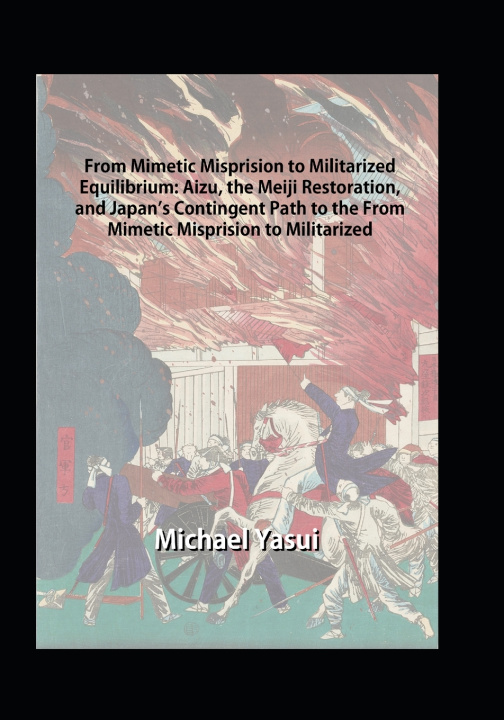
From Mimetic Misprision to Militarized Equilibrium
Aizu, the Meiji Restoration, and Japan's Contingent Path to the Asia-Pacific War.
 Inglese
 45 b
45 b
 In preparazione
 Nuovi
Nuovi
Fino a 30 giorni per il reso

This book reinterprets the Meiji Restoration as a struggle over how narratives of authority founded modern Japan. It rejects accounts of recovered sovereignty, inevitable modernization, or Tokugawa overthrow, reconstructing the 1860s through rival mediations of political order. Narrative assigns agency, organizes time, distinguishes legitimate force from rebellion, and defines possible futures. "Restoration" itself turns innovation into return, construction into recovery, and contingent victory into historical necessity.
Late Tokugawa Japan contained divided authority among the bakufu, domains, and imperial court. Aizu understood Tokugawa service through an ethical grammar linking retainer, lord, domain, shogunate, court, and realm. Its loyalty was not simply opposition to the emperor, but fidelity enacted through an inherited chain of authority. By contrast, Satsuma and Chōshū used court access to represent domainal armies and networks as instruments of imperial will. Sanction, military success, recognition, and institutional growth reinforced one another until a coalition could act as a national government.
The emperor functions as a contested signifier: a source of exceptional legitimacy whose meaning required interpretation and enforcement. The coalition occupied these channels while presenting its program as unmediated sovereign command. Toba-Fushimi made this transformation performative, as banners, military outcomes, allegiances, and expectations produced the legitimacy they later seemed merely to confirm. Civil violence was therefore constitutive, not incidental. Through the Boshin War and the designation chōteki, "enemy of the court," force and juridical naming displaced Aizu into the registers of rebellion, tragedy, and regional memory.
Aizu's defeat generated a counter-memory centered on suffering, Aizuwakamatsu, and the Byakkotai. The book preserves its ethical seriousness without making martyrdom political proof: victory cannot make the victor eternally correct, but suffering cannot make the defeated infallible. The same resistance to teleology shapes state formation: the abolition of the domains, conscription, national education, bureaucratic expansion, and the Constitution of 1889 were constructed after 1868, not destined by it. The victorious domains disappeared into the centralized state, while loyalty, service, discipline, honor, and sacrifice were detached from local relationships and redirected toward emperor and nation.
The central concept is mimetic misprision: actors mistake situated reenactments of inherited authority for its immediate presence. Political inheritance requires interpretation, yet authoritative performances conceal that labor by presenting judgment as obedience, interest as duty, and strategy as necessity. Aizu's loyalism and the coalition's imperial claims could both be sincere while historically mediated. The decisive difference was that one interpretation gained the coercive and institutional power to make its misrecognition binding.
Nash equilibrium explains how that interpretation became durable without universal agreement. Ritual, administration, conscription, schooling, and military organization coordinated expectations and raised the cost of departure. The Meiji Constitution preserved military autonomy within an emperor-centered order, allowing officers to present institutional judgment as sovereign service. Shōwa Restoration rhetoric repeated the same form: a pure emperor, corrupt mediators, and political intervention disguised as faithful return. Crisis, party weakness, imperial expansion, and escalating commitments hardened this structure into a militarized equilibrium and then lock-in. The road to the Asia-Pacific War was neither predetermined nor accidental, but a contingent passage from narrative struggle to institutional coordination.


Informazioni sul libro
Inglese
Categorie
