
 Contatto
 Come acquistare

Consegna
Guida all'acquisto
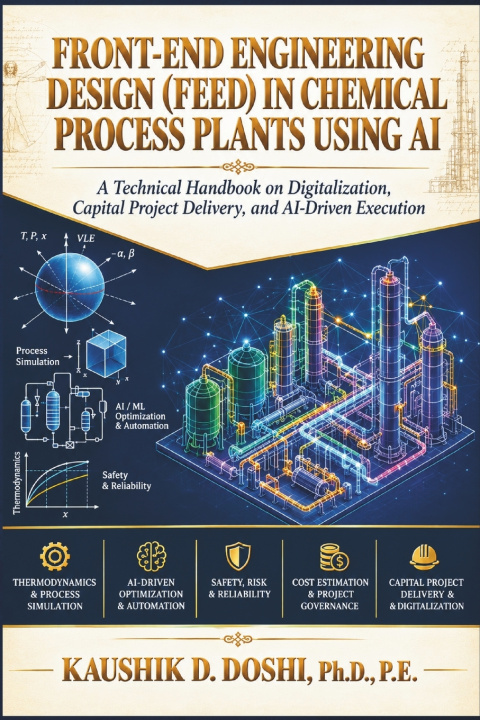
Front-End Engineering Design (FEED) in Chemical Process Plants Using AI
A Technical Handbook on Digitalization, Capital Project Delivery, and AI-Driven Execution
 Inglese
 185 b
 In preparazione
 Nuovi
Fino a 30 giorni per il reso

AI can generate engineering calculations in seconds. But can you trust the results enough to build a billion-dollar plant?
Artificial intelligence is transforming process engineering. Yet speed without verification can introduce costly errors, compromise safety, and undermine engineering integrity.
Front-End Engineering Design (FEED) represents only a small fraction of a capital project's investment, but the decisions made during FEED shape its economics, safety, reliability, and long-term operability.
The challenge is no longer simply knowing how to use AI. It is knowing what to ask, how to evaluate the results, and when engineering judgment must prevail.
Written by Kaushik D. Doshi, Ph.D., P.E., PMP, a process engineering leader with more than 25 years of experience in capital projects, this practical handbook bridges traditional engineering rigor with AI-powered efficiency.
WHAT YOU'LL LEARN
Master the PROMPT Method: Develop precise, structured engineering prompts that generate traceable, verifiable results.
Apply 60 Practical AI Cases: Explore realistic engineering applications supported by independently calculated reference answers.
Navigate the Complete FEED Workflow: Follow 12 chapters covering Basis of Design, process simulation, equipment sizing, safety, cost estimation, and digital twin handover.
Strengthen Technical Judgment: Reinforce essential concepts through chapter summaries, key takeaways, and a 120-question assessment with explained answers.
Understand AI-Generated Code: Examine 18 reviewed Python examples that demonstrate how engineering calculations can be generated, tested, and validated.
ENGINEERING APPLICATIONS INCLUDE
Process simulation and AI surrogate models • Equipment sizing using ASME and API standards • P&ID digitization • Heat integration and pinch analysis • HAZOP, relief sizing, LOPA, and SIL • Plant layout • Class 3 cost estimates and Monte Carlo contingency analysis • Digital handover and autonomous operations • AI governance and professional liability.
Every methodology is grounded in engineering fundamentals, thermodynamics, and recognized industry standards, including ASME, API, IEC 61511, ISA, and AACE.
No coding experience required. The emphasis is on practical AI applications, engineering reasoning, and independent verification-not becoming a software developer.
WHO SHOULD READ THIS BOOK?
An essential practical reference for chemical and process engineers, project engineers, process safety professionals, engineering managers, and graduate students preparing for an AI-enabled engineering industry.
Discover where AI adds value, where it can fail, and how to identify errors before they become costly design decisions or safety risks.
AI can accelerate engineering. Only sound engineering judgment can make the results trustworthy.
Stop asking AI for answers. Start asking it the right engineering questions.


Informazioni sul libro
Inglese

Regala questo libro oggi stesso
È facile
1 Aggiungi il libro al carrello e scegli la consegna come regalo 2 Ti invieremo subito il buono 3 Il libro arriverà all'indirizzo del destinatarioCiao! Sono Libroamiko, il tuo consulente di libri.
Come posso aiutarti?