
 Contatto
 Come acquistare
Consegna
Guida all'acquisto
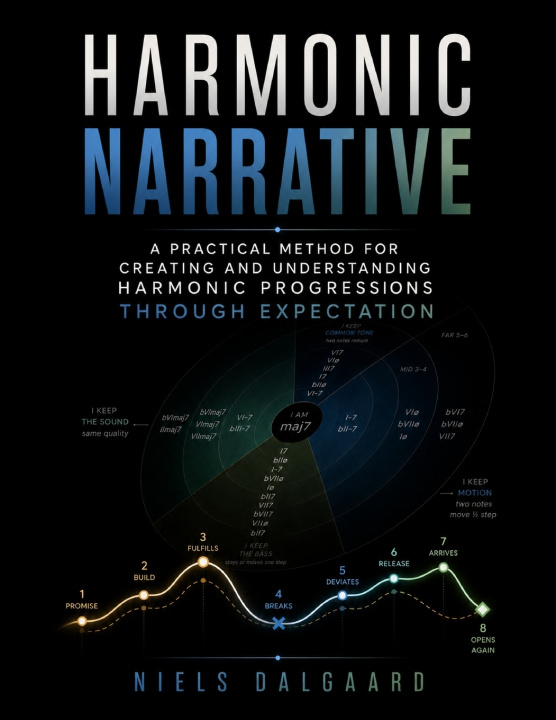
Harmonic Narrative
A practical method for creating and understanding harmonic progressions through expectation
 Inglese
 47 b
47 b
 In preparazione
 Nuovi
Nuovi
Fino a 30 giorni per il reso

WHAT MAKES US EXPECT A CHORD BEFORE WE HEAR IT?
Play this:
Cmaj7 Am7 Dm7 G7 Cmaj7
Now change the last chord to:
Abmaj7
Something happened.
And it happened before the chord sounded.
The four bars that came before it had already created an expectation. You were waiting for something. The Abmaj7 did not simply change the harmony. It changed what you thought was going to happen.
This book shows you how to create that effect deliberately.
Instead of asking:
"Which chord can follow this one?"
you begin with a more powerful question:
"What do I want the listener to expect?"
Should the next chord feel inevitable? Surprising? Delayed? Unstable? Like a return? Like something has been interrupted?
Once you define the experience you want, the harmony becomes a problem you can solve.
A DIFFERENT WAY TO THINK ABOUT HARMONY
The Expectation Framework turns harmonic decision-making into a practical procedure.
Rather than memorizing isolated chord progressions, you define the behavior you want from the music and then search for the chords that satisfy those conditions.
The result is not simply a chord with a name. It is a set of possible chords defined by what they do.
This gives you a systematic way to create tension, expectation, surprise, direction, and resolution, while keeping the final musical decision in your hands.
WHAT YOU WILL FIND INSIDE
Seven words, used in sequence, to guide harmonic decisions.
Five maps and four cards that take you from a musical intention to concrete chords.
Twelve devices of traditional harmony, including cadences, ii-V progressions, tritone substitutions, modal interchange, and secondary dominants, generated from their underlying behavior rather than simply memorized as formulas.
The larger families surrounding these devices, opening up many more possibilities.
Forty musical intentions expressed in clear, practical language.
Twenty-four figures to make the framework easy to visualize.
A reproducible worksheet for applying the method to your own music.
An appendix with the complete system in degrees, allowing you to work in all twelve keys.
WHO IS THIS FOR?
For musicians who already work with chords and want to understand why some harmonic choices feel inevitable while others feel surprising.
For guitarists, pianists, songwriters, composers, arrangers, producers, jazz musicians, and film and media composers.
You do not need to have studied functional harmony.
If you have, you will recognize many familiar harmonic sounds, only now you will see them from a different angle.
WHAT THIS BOOK DOES NOT DO
It does not compose for you.
It does something more useful: it reduces the possibilities.
Instead of staring at hundreds of possible chords, the framework narrows the field, eliminates choices that cannot satisfy your intention, and leaves the final decision where it belongs:
IN YOUR EAR.
It does not replace traditional harmony. It uses it, while organizing it around a different question:
"What do you want the listener to expect?"
Keep this book beside your guitar, piano, DAW, or manuscript paper. Follow the maps. Test the possibilities. Listen.
And instead of asking:
"What chord should come next?"
you will start asking:
"What do I want the listener to expect next?"
That is where harmonic choice becomes musical intention.


Informazioni sul libro
Inglese
Categorie
