
 Contatto
 Come acquistare
Consegna
Guida all'acquisto
Homo Textor
Weaving As (Technical) Mode of Existence
 Inglese
 86 b
86 b
 In preparazione
 Nuovi
Nuovi
 Termine sconosciuto
Fino a 30 giorni per il reso

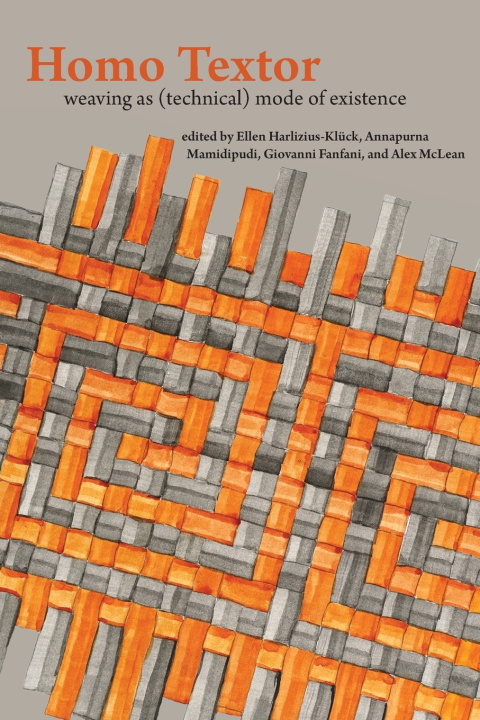
Homo Textor aims to exemplify how the (technical) mode of existence of weaving is able to provide concepts that help to rethink Homo faber and the way the Moderns (as described by Latour) talk about technology. The characteristic weaving mode is defined as histomorphism: a generative process where intelligible forms grow out of the loom-weaver-threads system contradicting the hylomorphic schema where an actor gives form to matter.
As the contributions in the book show, histomorphism, is not a technical mode restricted to the craft of weaving, but a concept providing a complex type of order that humans/actors identify in social, formal, cosmological, digital, and philosophical dimensions.
Positioned in the possibilities opened up by the 'Inquiry into Modes of Existence' project of Bruno Latour and the idea of Tim Ingold that making should be seen as a modality of weaving, the book provides case studies, performances, technical tools, speculative analyses, ethnographic studies, and philosophical revealing something about weaving that remains invisible if presented according to common disciplinary boundaries.
The contributions form clusters and socialize around challenges of referencing, terminology, technology, and form (part I), explorations of patterns as knowledge of order (part II), and stories about missing and seizing textile opportunities (part III), following an introductory chapter on Homo textor. The first part address established paradigms of production and making, such as the superimposition of form to matter (hylemorphism), the opposition of (extrinsic) structure and (intrinsic) substance, and the search for exact correspondences between terms and objects to which weaving poses a radical challenge. The papers in part II look at what weavers do and know and how this knowledge travels to other types of objects and beings as well as their relation to each other, the world in which they live, and how it is ordered. Part III brings together chapters demonstrating that considering seriously not only the textile object as outcome of a textile production process, but also the production process itself with its social relations and movements can take us to new perspectives not only in art, but also in coding and the development of new technologies


Informazioni sul libro
Inglese

Regala questo libro oggi stesso
È facile
1 Aggiungi il libro al carrello e scegli la consegna come regalo 2 Ti invieremo subito il buono 3 Il libro arriverà all'indirizzo del destinatarioCiao! Sono Libroamiko, il tuo consulente di libri.
Come posso aiutarti?