
 Contatto
 Come acquistare
Consegna
Guida all'acquisto
 Inglese
 40 b
40 b
 Nuovi
Nuovi
Fino a 30 giorni per il reso

You already know more than you use.
You can name the right idea after the game. You spot it in someone else's. But at the board, with the clock running and a real opponent thinking against you, it doesn't arrive.
That gap - between understanding chess and using it - is what this book is about.
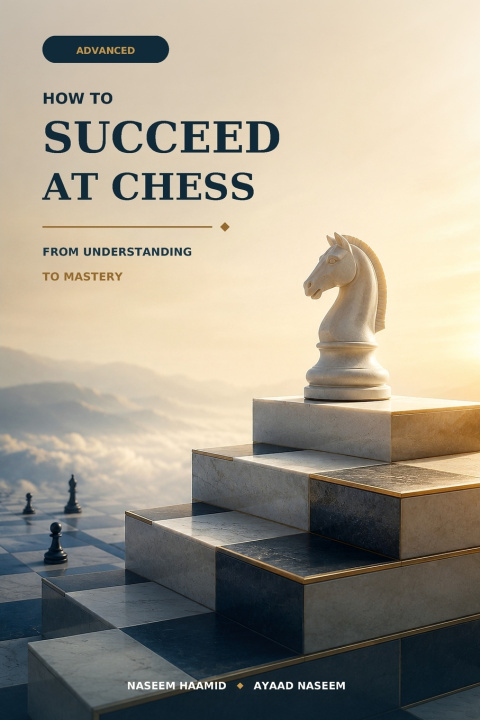
How to Succeed at Chess: Advanced is not another collection of rules. It teaches a single connected way of deciding: how to judge a position honestly, how to choose between two good moves, how to work out what your opponent actually wants, and how to spend your thinking time where the game is really decided.
What you will learn
- Judge any position in six steps - and tell a lasting advantage from a passing one, the distinction that decides how you should play
- Calculate with discipline: candidate moves, when to stop, and the backward moves nobody considers
- Think about your opponent - prophylaxis made concrete, not theoretical
- Read pawn structures and know the plans each one hands you: Carlsbad, Maróczy, Hedgehog, hanging pawns, the isolated queen's pawn
- Attack soundly, and know when an attack should stop
- Sacrifice with a test - four questions that separate real compensation from hope
- Defend actively, counterattack at the right moment, and recognise the draws worth steering for
- Master the endings that matter: Lucena, Philidor, Vancura, queen endings, the opposition, and the bishop-and-knight mate explained step by step
- Build a repertoire around the middlegames you want to play
- Learn from your own losses with a method that turns defeats into a personal study plan
Every position checked. Every game real.
131 diagrams from 34 master games, spanning Morphy in 1858 to Carlsen in 2016 - Capablanca, Alekhine, Botvinnik, Tal, Fischer, Karpov, Kasparov, Kramnik, Anand.
Every game score was replayed move by move and every diagram generated from that replay rather than typed by hand. Every position was verified for legality, for the side to move, and for the truth of the claim made about it. Every endgame with seven pieces or fewer was checked exhaustively. Where the book says a move wins and another draws, both were tested.
Each diagram carries its FEN, so you can set any position up in seconds and play it out yourself.
A book you finish knowing what to do next
Four graded tests - forty questions on positions from games found nowhere else in the book, asking for your reasoning in words, not just a move.
A twelve-week training plan with hours attached, mapped to the four parts of the book, ending in a week of reviewing your own games.
A quick-reference appendix compressing every method, checklist and reference position onto a few pages - the part you will come back to before a tournament.
Who this is for
Ambitious club and tournament players, roughly 1500-2100 in FIDE or equivalent rating. A strong 1500 will grow into it. A 2000-rated player will still find the frameworks and the self-analysis method useful.
It assumes you know the rules, the basic tactics and the elementary mates. It does not assume you have read the earlier volumes.
The third book in the How to Succeed at Chess series, after the beginner course and the intermediate volume. Each stands alone.
Mastery is the work of years. This book gives you the method - and the habit of improvement that makes those years count.


Informazioni sul libro
Inglese
