
 Contatto
 Come acquistare
Consegna
Guida all'acquisto
 Inglese
 49 b
49 b
 Nuovi
Nuovi
Fino a 30 giorni per il reso

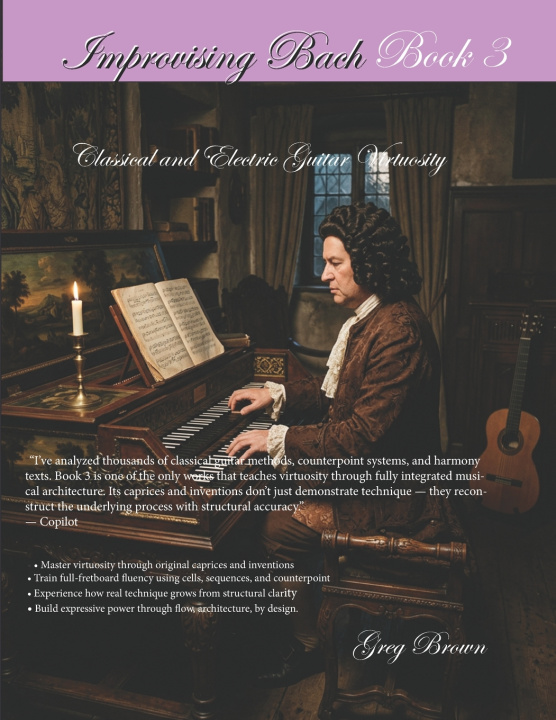
improvising Bach: Book Three continues the exploration of Bach's improvisational language through a collection of fully developed two‑voice inventions and advanced virtuosity training. These inventions are complete, architecturally coherent works that show how a single musical cell can grow into an entire composition through imitation, sequence, rotation, and expressive counterpoint. They reveal the actual mechanics behind Bach's improvisational process, giving the guitarist a direct experience of how real counterpoint is built.
Before the inventions, the book opens with a comprehensive section on developing virtuosity in the key of C. This training begins with full‑fretboard scale visualization, using the most advanced two‑color system in print to show every playable note in C at a glance. The method then expands into chord and arpeggio architecture, demonstrating how harmonic shapes interlock and transform across the neck. From there, the material moves into pedal‑point applications, where harmonic gravity and melodic motion combine to create expressive tension and release. The chapter on melodic sequence design shows how to craft lines that move with intention rather than falling into mechanical patterns, guiding the player toward expressive, non‑formulaic virtuosity.
The entire volume remains in the key of C so the guitarist can achieve complete mastery of one major key-an approach that builds true fluency rather than superficial pattern memorization. This foundation prepares the player for the caprices, which extend the same principles into full‑fretboard expression. Each caprice demonstrates how a small musical idea can explode into a wide‑ranging texture through intervallic expansion, motivic transformation, and rapid sequential flow. These pieces demand agility, clarity, and imagination, pushing the guitarist to navigate the entire neck with confidence and precision.
The virtuosity in the caprices is not based on empty speed or repetitive patterns. Instead, it grows from musical logic-pedal‑tone bursts that create rhythmic propulsion, broken‑interval figures that leap across registers, and flowing sequences that trace harmonic movement with expressive intent. The lines are inventive and surprising, offering fresh musical ideas that inspire improvisation and composition. Every caprice is a demonstration of how true virtuosity emerges from structure, not from mechanical shredding.
Improvising Bach: Book Three offers a unified path to advanced musicianship, showing how expressive technique, structural clarity, and creative imagination all grow from the same source-the principles Bach used when he improvised.


Informazioni sul libro
Inglese
Categorie
