
 Contatto
 Come acquistare

Consegna
Guida all'acquisto
 Inglese
 48 b
 Nuovi
Fino a 30 giorni per il reso

Information is not what you know. It is what someone else does not.
The popular view holds that knowledge is power: the expert, the archive, the slogan carried for four centuries since Francis Bacon wrote it down.
The slogan is half right.
Knowledge held by everyone confers nothing on anyone. The scribe who could read the tablet, the general who knew where the enemy slept, the merchant who learned the harvest had failed before the price moved: none of them held an advantage of strength, wealth, or virtue. Each held a difference, and each spent it before the difference closed.
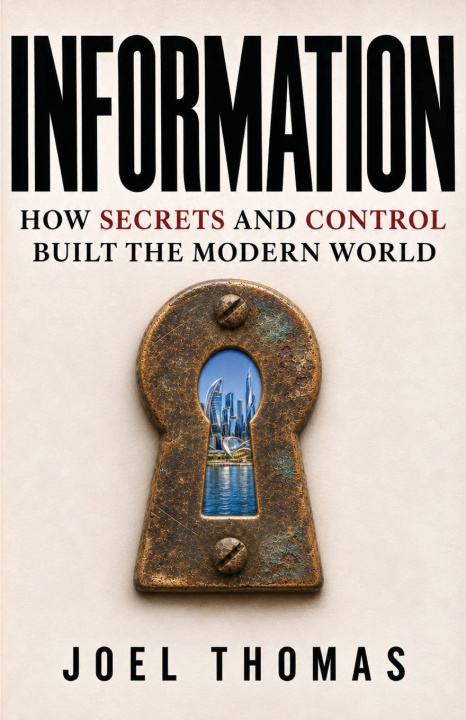
In Information: How Secrets and Control Built the Modern World, Joel Thomas examines information not as content, truth, or enlightenment, but as asymmetry: the gap between the party who knows and the party who does not, and the oldest source of leverage in human affairs. Across five thousand years, from the first clay ledger to the algorithmic feed, the carriers changed completely and the relationship did not.
Every age argues about the water: the pamphlet, the broadcast, the post. Almost no one asks who owns the pipe.
This book follows the pipe.
Inside, you will examine:
Why the first records were not poems or prayers but inventories, and why power learned to write so it could count what it owned
Why every secret is a small, unstable engine whose security falls with each person who holds it
How surveillance moved from the paid informer to the device the watched now carry themselves, and why the fear of the file always mattered more than the file
How propaganda and censorship work as one instrument, one terminal supplying belief and the other removing its rivals
Why the English crown never needed to read what the printers printed, and why owning the carrier has always outranked controlling the content
Why the leak is the secret's permanent failure mode, and why disclosures have grown by orders of magnitude while the reforms have not
How markets price knowledge to the microsecond, and why the market that aggregates information and the market that exploits it are one market
Why falsehood has always outrun its correction, and what the present environment has done to its economics
Why abundance did not abolish scarcity but moved it, from information to attention, and who now holds the channel
Drawing from history, economics, political theory, intelligence studies, and media history, Information follows the asymmetry from the granaries of Mesopotamia to the East German informer, from the telegraph wire and the undersea cable to the data broker and the platform. The technologies share almost nothing. The pattern beneath them repeats in every medium: monopoly, disruption, reconcentration.
This is not a book about technology.
It is not an argument that information should be free, or that it should be controlled.
It is not a story of progress. The printing press did not end the monopoly on knowledge. It transferred it.
It is a diagnostic framework for understanding who owns the gap, and what the gap buys.
Information is the seventh volume in the series that began with Power and continued with Fear, Control, Risk, Wealth, and Trust. Power selects the bets. Fear misprices them. Control decides who may object. Risk keeps the ledger, Wealth is where it is all stored, and Trust is what every one of them runs on. Information is what each of them knows that someone else does not.
If you want to know why every liberating technology ends in a new monopoly, why the best-informed age in history is starved for attention, and who keeps the ledger now, this book hands you the floor plan.


Informazioni sul libro
Inglese
Categorie

Regala questo libro oggi stesso
È facile
1 Aggiungi il libro al carrello e scegli la consegna come regalo 2 Ti invieremo subito il buono 3 Il libro arriverà all'indirizzo del destinatarioCiao! Sono Libroamiko, il tuo consulente di libri.
Come posso aiutarti?