
Entra a far parte di una comunità di amanti dei libri di tutto il mondo e ottieni numerosi vantaggi.
Crea un account gratuito
Punto Poste 5.49 €
Punto Poste 5.49 €
Corriere DHL 6.99 €
Corriere GLS 5.99 €
Punto GLS 4.49 €
Corriere Bartolini 4.49 €
Punto Bartolini 3.49 €
 Contatto
 Come acquistare
Aiuto
Consegna
Punto Poste 5.49 €
Punto Poste 5.49 €
Corriere DHL 6.99 €
Corriere GLS 5.99 €
Punto GLS 4.49 €
Corriere Bartolini 4.49 €
Punto Bartolini 3.49 €
Guida all'acquisto
Il mio account
▸
Vuoto :-(
0
Lapidary Made Easy for Beginners
A Step-by-Step Guide to Cutting, Polishing, Faceting, and Tumbling Rough Stones into Finished Gems
Lingua
 Inglese
Inglese
Libro
In brossura
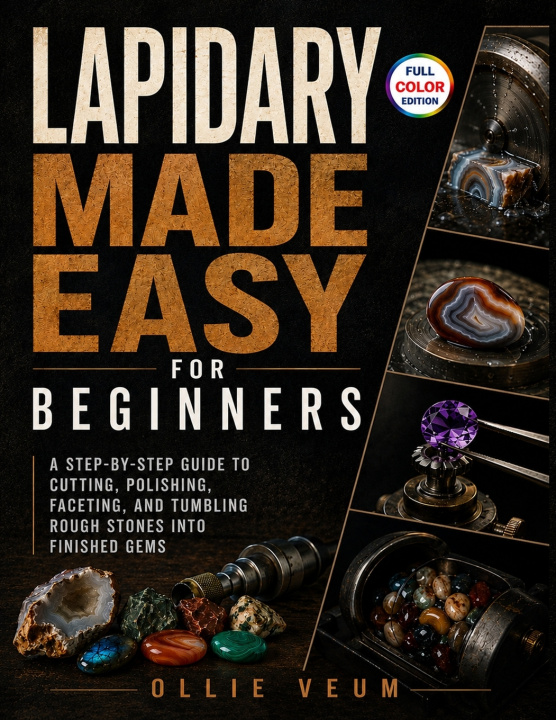
Three techniques. Fifteen chapters. One rough, unremarkable stone from a windowsill or a junk drawer...
Descrizione completa
Codice Libristo: 53374713
?
 52 b
52 b
 In preparazione
 Nuovi
Nuovi
52 b
In preparazione
Nuovi
21.29
€
Immagazzinamento previsto
Pubblicazione 02. 08. 2026
Fino a 30 giorni per il reso

Three techniques. Fifteen chapters. One rough, unremarkable stone from a windowsill or a junk drawer is genuinely enough to begin.
Tumbling, cabbing, and faceting are taught in that exact order, each one deliberately handing the next technique the hand skills and material judgment it depends on. Nothing here is assumed going in. Every tool, material, and grit stage is explained from first principles.
What Fifteen Chapters Build
- Judge a piece of rough material by hardness and structure before it ever meets a saw blade
- Run a complete four-stage tumble from a coarse grit all the way through a mirror-bright finish
- Cut, dome, and hand-sand a cabochon on a trim saw and a combination grinding and sanding unit
- Dop a stone correctly and know exactly when wax gives way to a stronger dop adhesive
- Set precise faceting angles facet by facet, working from the table down to the pavilion
- Drill, finish, and present a stone so the finished result reads as intentional craftsmanship
- Build a home workspace around water management and safety before buying a single tool
None of this depends on natural talent. It depends on patience, applied one grit stage at a time, chapter after chapter, stone after stone, long before the final polish ever shows up.
The Troubleshooting Built In
- Diagnose cloudy stones, uneven domes, and stalled tumbles before a whole batch is lost
- Read scratch patterns correctly to know when a grinding stage is genuinely finished
- Fix a barrel that leaks, stalls mid-cycle, or develops a foul odor between grit stages
- Set up water flow, ventilation, and eye protection correctly from the very first session
- Recognize when a batch is genuinely unsalvageable instead of chasing a lost cause
Fifteen chapters. Three techniques. No prior experience required anywhere in these pages, only the patience to let tumbling, cabbing, and faceting each take exactly the time they take, one grit stage and one finished stone at a time.
Turn to Chapter 1, and start reading a stone before it ever meets a saw blade.
Attrice
&
Poliglotta
EWA KASP
per
Riproduci video


Libristo ha la più grande selezione di letteratura in lingue straniere. Per questo compro i miei libri qui.
Informazioni sul libro
Titolo completo
Lapidary Made Easy for Beginners
Autore
Ollie Veum
Lingua
Inglese
Inglese
Rilegatura
Libro - In brossura
Data di pubblicazione
2026
Numero di pagine
134
EAN
9798189633607
Codice Libristo
53374713
Casa editrice
Independently published
Peso
330
Dimensioni
216 x 280 x 7

Regala questo libro oggi stesso
È facile
1 Aggiungi il libro al carrello e scegli la consegna come regalo 2 Ti invieremo subito il buono 3 Il libro arriverà all'indirizzo del destinatario
Consulente di libri Libroamiko
Utilizzando questa chat, stai comunicando con un'intelligenza artificiale generativa. Utilizzandola, accetti anche il trattamento dei dati personali.
Ciao! Sono Libroamiko, il tuo consulente di libri.
Come posso aiutarti?
Ciao, sono Libroamiko, posso aiutarti?