
 Contatto
 Come acquistare
Consegna
Guida all'acquisto
Mate Me
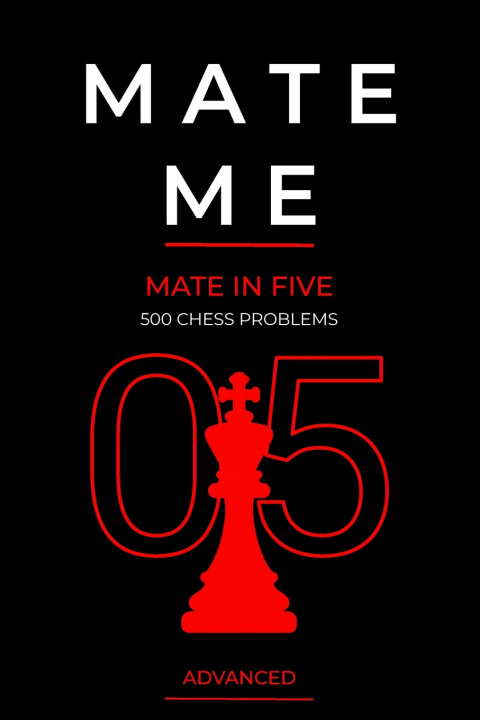
500 Mate in Five Chess Problems: Advanced Chess Problems for Deep Calculation, Visualization, and Tactical Training
 Inglese
 27 b
27 b
 Nuovi
Nuovi
Fino a 30 giorni per il reso

Welcome to Mate Me
Chess is a game of patterns, calculation, and problem solving. The more positions you work through, the more you start to recognize those patterns when they show up again.
That's the idea behind Mate Me: solve a lot of chess problems and get better at seeing the solution.
Mate Me was designed to make that practice simple. Each book gives you hundreds of chess problems to work through, arranged to become progressively more challenging as you go.
One board. One problem. Find the mate.
There are no pieces to move and no computer waiting to tell you whether your first idea was right. Study the position, consider the possibilities, and calculate the solution before turning to the answer.
That matters.
Solving from a static board forces you to calculate instead of click. You have to visualize the moves, anticipate the defense, and work out the continuation yourself rather than relying on trial and error.
The computer isn't moving the pieces for you.
Your brain has to.
And because this is the print edition, there's nothing between you and the position. No screen, no app, and no notifications. Just a chessboard on the page and a problem waiting to be solved.
Take your time. Calculate as far as you need to. If you aren't sure, look again before checking the solution. Some problems will come quickly. Others may take a while. That's part of the process.
That's what Mate Me is about: a simple way to work through a lot of chess problems, one at a time, at your own pace.
Study the board. Calculate the moves. Find the mate.
About This Book
Book 5 is the advanced part of the main Mate Me progression.
The problems in this book range from approximately 1800 to 2300 and are arranged to get harder as you go. The ratings use the Glicko-2 rating system and are based on how difficult the problems have been for people to solve.
Every problem is Mate in Five. You'll know that checkmate is there, but finding the sequence that gets you there is another matter.
The early problems start around the 1800 level. There may still be forcing checks and recognizable mating ideas, but you'll need to calculate much further before you can be sure the first move actually works.
As you move through the book, expect more pieces, more defensive resources, more convincing alternatives, and more opportunities for one inaccurate assumption to ruin the entire line. A move can look perfect for several moves before you discover that the king has an escape square or the defender has a resource you missed.
By the end of the book, you'll be working on problems approaching the 2300 level.
At this level, the goal isn't just finding checks. It's comparing candidate moves, eliminating lines that don't work, visualizing the resulting positions, and staying accurate several moves into the calculation.
Try to solve each problem directly from the printed position and calculate the full sequence before checking the solution. The further ahead you calculate, the more important it becomes to keep track of where every piece will be rather than where it started.
The ratings aren't grades, and they're definitely not a prediction of your playing rating. They're simply a useful way to organize the problems. Some positions will fit patterns you recognize immediately, while others may keep you staring at the board for quite a while.
By the time you reach the end of Book 5, you'll have worked your way from one-move checkmates in Book 1 to combinations that require you to calculate five moves deep.
If you're still looking for something harder, there's one book left.


Informazioni sul libro
Inglese
