
 Contatto
 Come acquistare
Consegna
Guida all'acquisto
 Inglese
 43 b
43 b
 In preparazione
 Nuovi
Nuovi
 Pubblicazione 29. 09. 2026
Fino a 30 giorni per il reso

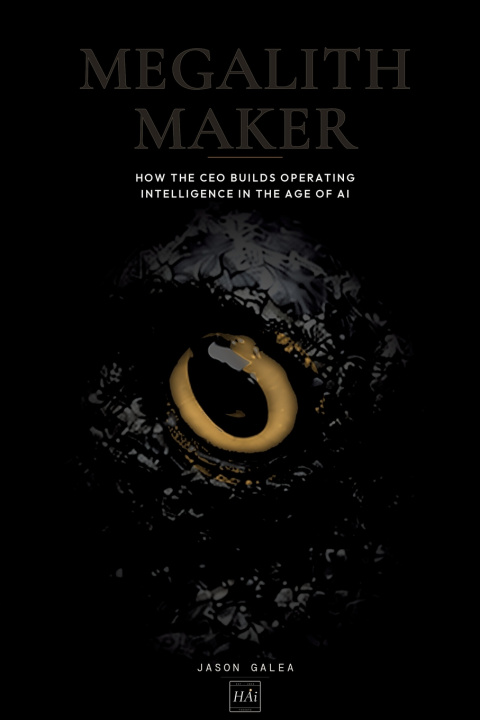
The organizations that win the AI age will not simply use intelligence. They will be designed for it.
The management philosophy that shaped the modern corporation was built for another era. Frederick Winslow Taylor made work visible, predictable, and controllable. Max Weber made authority rational, procedural, and scalable. Their ideas helped organizations achieve extraordinary size and reliability. But the same architecture now constrains the judgment, learning, and responsiveness that contemporary competition demands.
Megalith Maker argues that many of the problems leaders experience as people problems are actually design problems. Disengagement, cognitive overload, slow decisions, lost knowledge, brittle coordination, and innovation that escapes the enterprise are not isolated failures. They are symptoms of organizations engineered for repetition in an environment that increasingly rewards adaptation.
Drawing on systems theory, organizational learning science, behavioral research, and case evidence from Toyota, Spotify, Haier, Microsoft, Moderna, DBS Bank, Automattic, and others, Jason Galea describes an alternative: the organization built around operating intelligence. Such an organization continuously senses what is changing, distributes judgment closer to where information emerges, retains what it learns, uses AI to strengthen rather than replace human cognition, and adapts its structures and workflows as conditions change.
At the center of this transformation is a role most organizations have underestimated: the Chief Learning Officer. Megalith Maker reconceives the CLO not as the custodian of training programs, but as an architect of enterprise cognition and a critical partner to the CEO. The modern CLO shapes how knowledge is acquired and applied, how decision rights are structured, how feedback travels, how capability is built and redeployed, and how AI-assisted judgment is governed. Learning, in this model, is not a service delivered to the organization. It is infrastructure through which the organization operates.
The result is what Galea calls the Megalith: an enterprise capable of sensing, deciding, learning, and adapting at scale. In a Megalith, size becomes an advantage because intelligence is embedded throughout the system rather than concentrated at the top.
Written for CEOs, board members, Chief Learning Officers, and senior executives, Megalith Maker offers a rigorous but accessible framework for understanding what organizational advantage looks like when human and artificial intelligence work together. Its central proposition is simple: the organizations that learn how to build intelligence into their operating architecture will shape the markets, workforces, and institutions that follow.


Informazioni sul libro
Inglese

Regala questo libro oggi stesso
È facile
1 Aggiungi il libro al carrello e scegli la consegna come regalo 2 Ti invieremo subito il buono 3 Il libro arriverà all'indirizzo del destinatarioCiao! Sono Libroamiko, il tuo consulente di libri.
Come posso aiutarti?