
 Contatto
 Come acquistare
Consegna
Guida all'acquisto
New Geometric Data Structures for Collision Detection and Haptics
 Inglese
 132 b
132 b
Fino a 30 giorni per il reso
I clienti hanno acquistato anche


 /
/
 In brossura
 14.19
€
14.19
€




 /
In brossura
1.59
€
/
In brossura
1.59
€











 /
In brossura
37.69
€
/
In brossura
37.69
€



 /
In brossura
40.69
€
/
In brossura
40.69
€







 /
In brossura
27.39
€
/
In brossura
27.39
€
 /
In brossura
29.49
€
/
In brossura
29.49
€

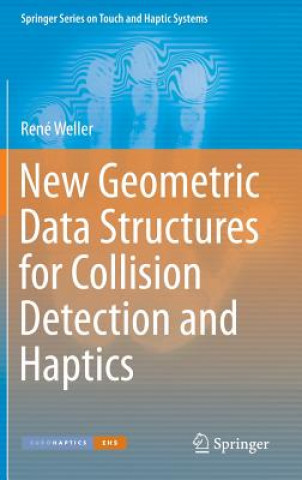
Starting with novel algorithms for optimally updating bounding volume hierarchies of objects undergoing arbitrary deformations, the author presents a new data structure that allows, for the first time, the computation of the penetration volume. The penetration volume is related to the water displacement of the overlapping region, and thus corresponds to a physically motivated and continuous force. The practicability of the approaches used is shown by realizing new applications in the field of robotics and haptics, including a user study that evaluates the influence of the degrees of freedom in complex haptic interactions. New Geometric Data Structures for Collision Detection and Haptics closes by proposing an open source benchmarking suite that evaluates both the performance and the quality of the collision response in order to guarantee a fair comparison of different collision detection algorithms.§Required in the fields of computer graphics, physically-based simulations, computer animations, robotics and haptics, collision detection is a fundamental problem that arises every time we interact with virtual objects. Some of the open challenges associated with collision detection include the handling of deformable objects, the stable computation of physically-plausible contact information, and the extremely high frequencies that are required for haptic rendering. New Geometric Data Structures for Collision Detection and Haptics presents new solutions to all of these challenges, and will prove to be a valuable resource for researchers and practitioners of collision detection in the haptics, robotics and computer graphics and animation domains.


Informazioni sul libro
Inglese
Categorie

Regala questo libro oggi stesso
È facile
1 Aggiungi il libro al carrello e scegli la consegna come regalo 2 Ti invieremo subito il buono 3 Il libro arriverà all'indirizzo del destinatarioPotrebbe interessarti anche






 /
In brossura
64.79
€
/
In brossura
64.79
€


 /
Rigido
62.89
€
/
Rigido
62.89
€









 /
In brossura
31.49
€
/
In brossura
31.49
€






Ciao! Sono Libroamiko, il tuo consulente di libri.
Come posso aiutarti?