
 Contatto
 Come acquistare
Consegna
Guida all'acquisto
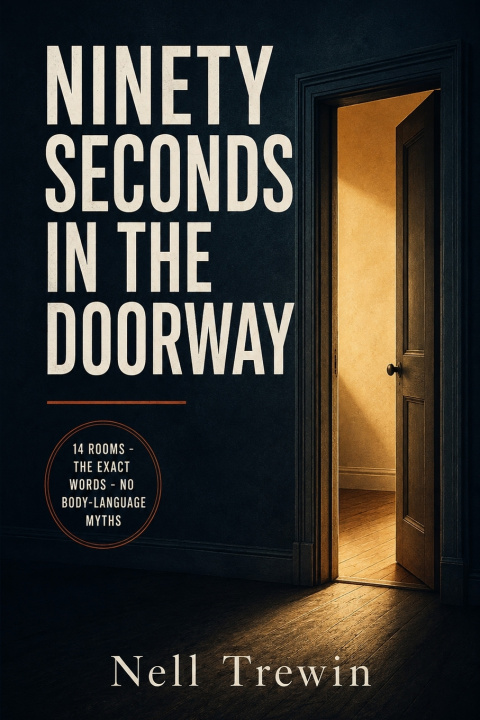
Ninety Seconds in theDoorway
 Inglese
 89 b
89 b
 Nuovi
Nuovi
Fino a 30 giorni per il reso

The door sighs shut behind you and the room noise comes up all at once. Forty people, maybe fifty, already standing in threes and fours. Your coat is over your arm and your right hand has nothing in it.
You have about ninety seconds.
Most books about talking to strangers give you principles. Ask open questions. Show interest. Be curious. All true, all useless at the moment the door closes, because a principle is not a sentence and what you need is a sentence.
This book goes two levels lower. Fourteen moments where a conversation is actually decided, one per chapter, each one a specific room at a specific second, with the exact words that work in it.
THE FOURTEEN MOMENTS
The doorway, in the first eight steps · the person standing alone at the edge, when you are the one who walks over · the food table, which is the easiest place in the building · the elevator, where you have thirty seconds and not ninety · the silence after "and what do you do?" · the group standing in a closed horseshoe · being introduced and then abandoned ten seconds later · the five minutes before anything official starts · the seat you were given, next to someone for two hours · the face you know when the name is gone and they are six feet away · being left with one person when the others drift off · the pause in the middle of a conversation that was going well · leaving, without inventing an errand · and the second time, a week later, in the same room.
WHAT IS IN EVERY CHAPTER
THE SCENE puts you there, in the present tense, and ends at the exact second something has to happen.
WHAT IS ACTUALLY HAPPENING is the part other books skip: what the situation is made of, including what it looks like from the other side.
THE FIRST NINETY SECONDS is the longest part, and it is made of actual sentences - the line, the two or three answers you are most likely to get back, and what to do with each of them. There is at least one full conversation written out in every chapter. In some of them a joke dies. In some of them somebody answers in one word.
WHEN IT DOES NOT WORK is not a formality. Sometimes the other person does not want to talk, and the skillful thing is to leave well rather than try harder.
AFTER THE NINETY SECONDS is how the window closes: how it becomes ten minutes, or how it ends cleanly.
WHAT THIS BOOK WILL NOT TELL YOU
It will not tell you what folded arms mean. There is no chapter on reading people, no guide to decoding a posture, no method for telling boredom from a bad day. Most of what circulates on that subject cannot be checked, and a book that hands a nervous reader more ways to interpret a stranger's shoulder is making things worse. Where another book would tell you to read a signal, this one gives you a sentence that makes reading unnecessary.
There is no research in it either, and it says so on the copyright page. No studies, no percentages, no experiments, no clients, no case files. The examples were composed for the page and are declared as compositions. What is here is observation and practice, offered as exactly that.
And there is nothing here about steering anyone toward anything. No rapport techniques, no way to be liked faster, nothing that only works while the other person does not know it is being used. The aim is a conversation, not an outcome.


Informazioni sul libro
Inglese

Regala questo libro oggi stesso
È facile
1 Aggiungi il libro al carrello e scegli la consegna come regalo 2 Ti invieremo subito il buono 3 Il libro arriverà all'indirizzo del destinatarioCiao! Sono Libroamiko, il tuo consulente di libri.
Come posso aiutarti?