
 Contatto
 Come acquistare
Consegna
Guida all'acquisto
 Inglese
 77 b
77 b
 Nuovi
Nuovi
Fino a 30 giorni per il reso

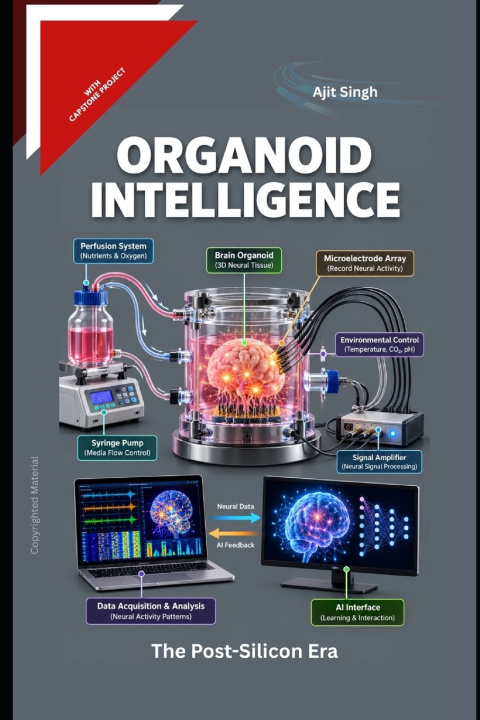
Organoid Intelligence: The Post-Silicon Era is a definitive, hands-on engineering textbook meticulously designed to bridge the chasm between computer science and neurobiology. As the technology sector shifts away from traditional silicon-based architectures toward energy-efficient, highly parallel biological computing, this book serves as the ultimate practical guide. It is explicitly tailored to meet the exact syllabus requirements of international universities for the upcoming academic year, while simultaneously addressing the urgent, emerging demands of the commercial technology industry.
Philosophy
The central philosophy of this book is grounded in applied engineering and practical implementation. For too long, the field of Organoid Intelligence has been dominated by biological theory, cellular mechanics, and speculative neuroscience. This book fundamentally rejects the purely theoretical approach. Instead, it treats biological neural networks (organoids) as specialized hardware components as computational nodes that can be designed, interfaced with, programmed, and deployed into production environments. The philosophy dictates that biology, in the context of IT, must be engineered.
Key Features
1. Comprehensive Coverage: Exactly 10 logically sequenced chapters covering every facet of OI, from fundamental setups to final cloud-integrated deployment.
2. Strict Adherence to Chapter Specifics: The introductory chapter thoroughly covers definitions, history, evolution, versions, successor comparisons, classifications, features, components, advantages, and applications.
3. Capstone DIY Project: The final chapter is entirely dedicated to a complete, live, working DIY capstone project, providing full working code, step-by-step explanations, and deployment instructions for a Bio-Digital Pattern Recognition System.
4. Industry-Relevant Architecture: Detailed blueprints for modern wetware-software interfaces, including Microelectrode Array (MEA) data translation, signal encoding/decoding, and biological life-support automation.
5. Focus on Productionization: Unlike laboratory manuals, this book details how to take an OI model from a controlled environment and deploy it into a commercial production environment, addressing scaling, API creation, and edge computing.
6. Troubleshooting & Maintenance: Practical guides on managing the unique challenges of biological computing, including signal noise reduction, cellular longevity, and bio-security.
7. Algorithm Simplification: Every coding and training protocol is distilled into sequential lists for rapid comprehension and immediate coding application.
Key Takeaways
Upon completion of this book, the reader will possess the knowledge and practical skills to:
1. Understand the foundational components, history, evolution, and classification of Organoid Intelligence systems.
2. Design and set up a basic biological computing environment, understanding the hardware (MEAs) and life-support microfluidics required.
3. Develop bio-digital interfaces that successfully translate digital data (Python/C++ code) into electrical stimuli for biological cells, and vice versa.
4. Implement simple, step-by-step algorithms to train organoids for specific tasks using stimulus-response and biological reinforcement learning protocols.
5. Architect and develop complete software applications that utilize biological organoids as the primary processing unit.
6. Deploy and productionize OI systems, integrating them with traditional cloud services, APIs, and edge computing networks.
Disclaimer: Earnest request from the Author.
Kindly go through the table of contents and refer to the kindle edition for a glance on the related contents.
Thank you for your kind consideration!


Informazioni sul libro
Inglese

Regala questo libro oggi stesso
È facile
1 Aggiungi il libro al carrello e scegli la consegna come regalo 2 Ti invieremo subito il buono 3 Il libro arriverà all'indirizzo del destinatarioCiao! Sono Libroamiko, il tuo consulente di libri.
Come posso aiutarti?