
 Contatto
 Come acquistare

Consegna
Guida all'acquisto
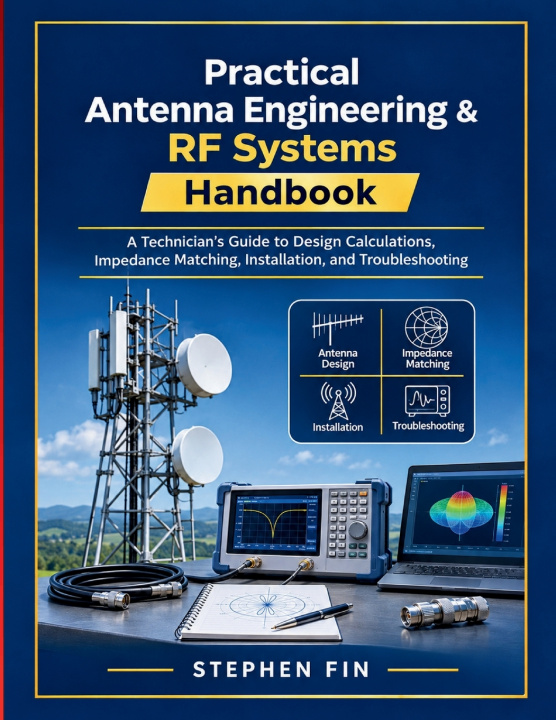
Practical Antenna Engineering & RF Systems Handbook
A Technician's Guide to Design Calculations, Impedance Matching, Installation, and Troubleshooting
 Inglese
 163 b
 In preparazione
 Nuovi
Fino a 30 giorni per il reso

A low standing-wave ratio answers one question about an antenna system. It does not, by itself, tell you where the energy is going, whether the feed system is behaving as expected, or why a wireless link is still weak.
This handbook connects antenna calculations with transmission-line behavior, measurement practice, installation effects, and the evidence needed to investigate RF performance.
Across eighteen chapters, the material progresses from RF fundamentals into antenna selection, impedance matching, transmission lines, modeling, installation, measurement, and system verification.
Begin with impedance, reflections, cable loss, return loss, standing-wave ratio, and Smith-chart interpretation. Then explore major antenna families including dipoles, monopoles, loops, verticals, Yagi and other directional designs, compact antennas, and arrays.
Use the handbook to:
• Compare antenna types according to radiation behavior, installation constraints, and intended application.
• Relate transmission-line loss, impedance, connectors, and reference-plane choices to measured results.
• Follow matching calculations and interpret reflection coefficient, return loss, and standing-wave information.
• Use Smith charts to understand impedance transformation and matching relationships.
• Plan vector network analyzer measurements and recognize why calibration and measurement-plane placement matter.
• Compare simulated behavior with field measurements while keeping model assumptions visible.
• Examine radiation patterns, gain, directional behavior, arrays, and beamforming.
• Develop wireless link budgets and consider propagation losses when evaluating system performance.
• Troubleshoot weak or unexpected performance by separating antenna, feedline, connection, installation, and measurement effects.
Worked calculations keep the assumptions behind each result visible. Integrated fault cases ask you to decide what the available evidence establishes and which next measurement would reduce uncertainty.
Later chapters bring together environmental effects, arrays, installation considerations, measurement strategy, and complete design-and-verification projects.
Illustrations, technical examples, reference material, a glossary, and an index support both structured study and focused review of a particular task, such as setting a measurement reference plane, checking a feed system, or reconciling field results with expected behavior.
The handbook is written for technicians, technically minded radio experimenters, RF learners, and engineering students who want to understand the complete signal path rather than treating antenna construction as the end of the process.
Analytical examples are teaching models. Actual installation, regulatory, safety, and acceptance decisions require appropriate measurements, equipment documentation, and applicable requirements.
Start with a design question, state the assumptions, follow the RF path, and finish with a result you can measure and explain.


Informazioni sul libro
Inglese

Regala questo libro oggi stesso
È facile
1 Aggiungi il libro al carrello e scegli la consegna come regalo 2 Ti invieremo subito il buono 3 Il libro arriverà all'indirizzo del destinatarioCiao! Sono Libroamiko, il tuo consulente di libri.
Come posso aiutarti?