
 Contatto
 Come acquistare

Consegna
Guida all'acquisto
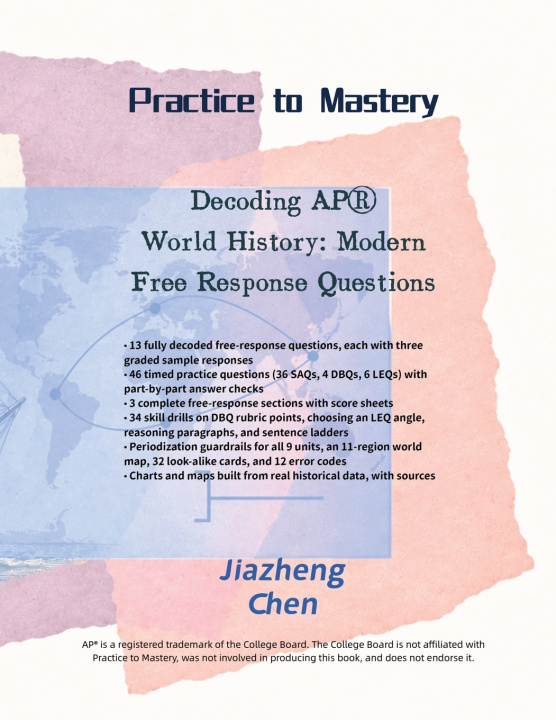
Practice to Mastery
Decoding AP World History: Modern Free Response Questions
 Inglese
 165 b
 Nuovi
Fino a 30 giorni per il reso

Most students who score a 2 or 3 on the AP® World History: Modern Exam know more history than their score shows. They lose points on the free-response section for reasons a reader can name in a few words: evidence from the wrong century, an example from the wrong region, an ideology named but never explained, sourcing that only repeats the source line, a thesis with no line of reasoning. This book shows you exactly what readers reward, line by line, and then makes you practice until earning those points becomes a habit.
Written for the redesigned exam first given in May 2027, it covers every free-response question type in the new format: three required short-answer questions (a historian's interpretation, a primary text, and a non-text source such as an image, map, or chart), one required document-based question on a topic between 1200 and 2001, and one required long essay question with a broad prompt that spans roughly half the course.
Every question chapter follows the same three steps:
Learn: fully decoded examples, usually with three original student responses at different score levels and a point-by-point decode showing which sentence earns or loses each point, and why.
Practice: timed questions you answer yourself before looking at anything else.
Check: a rubric for every practice question, acceptable answers drawn from different world regions, the most common ways students lose each point, and a strict Score Yourself checklist. Every full DBQ and LEQ check includes a model full-credit essay and a decoded essay that falls short of full credit.
Twelve error codes, E1 through E12, label every lost point in the book, so you can find your own pattern and fix it. The Toolkit gives you the reference tools that prevent the most common World History mistakes:
Look-Alike Pairs: 32 cards on developments students confuse, from Song versus Yuan rule to negotiated versus armed decolonization.
Periodization and Region Guardrails: what counts as evidence inside each of the nine units' time windows, labels with default dates, a world regions map, and the "modern trap" list of twenty-first-century examples that never count.
The Sentence Ladder: how to turn a name-drop into an explanation that earns credit.
Connection Maps: how to link developments across periods and regions for the complexity point.
The book ends with three complete, timed free-response sections, each with three short-answer questions, a DBQ, and an LEQ, fully scored and decoded.
All content is original. Historian passages, sample responses, charts, and maps were created for this book. Primary sources are verified public-domain documents and translations, cited with author, title, and date, or clearly labeled period-style documents written for practice. Coverage is balanced across Africa, the Americas, East Asia, South and Southeast Asia, the Middle East, and Europe.
Use it on its own, or with its companions in the Practice to Mastery series: Practice to Mastery: AP® World History: Modern Workbook and Practice to Mastery: AP® World History: Modern Practice Exams.
AP® and Advanced Placement® are registered trademarks of the College Board, which was not involved in the production of, and does not endorse, this product.


Informazioni sul libro
Inglese

Regala questo libro oggi stesso
È facile
1 Aggiungi il libro al carrello e scegli la consegna come regalo 2 Ti invieremo subito il buono 3 Il libro arriverà all'indirizzo del destinatarioCiao! Sono Libroamiko, il tuo consulente di libri.
Come posso aiutarti?