
 Contatto
 Come acquistare
Consegna
Guida all'acquisto
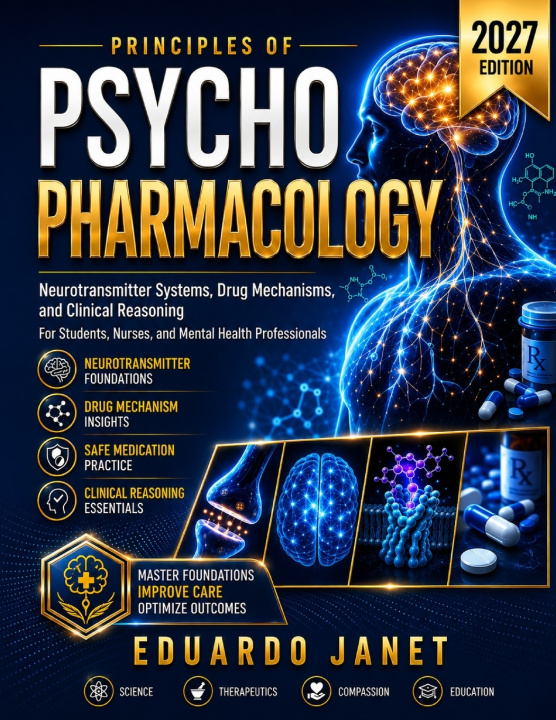
PRINCIPLES OF PSYCHOPHARMACOLOGY
Neurotransmitter Systems, Drug Mechanisms, and Clinical Reasoning For Students, Nurses, and Mental Health Professionals
 Inglese
 Nuovi
Nuovi

Learn how psychiatric medications actually work in the brain, and why almost every side effect is predictable rather than something to memorize, with Principles of Psychopharmacology. This book follows the complete chain from a single synapse to a clinical observation at the bedside, organized in the order the machinery is built rather than alphabetically by drug. Thirty-two chapters across eight parts cover neuronal signaling, the neurotransmitter systems, pharmacokinetics and drug interactions, antidepressants, antipsychotics, mood stabilizers and anxiolytics, special populations, and applied clinical reasoning. Mechanism in Focus boxes, Common Misconception callouts, worked Clinical Reasoning cases, comparison tables, and Verify Before Use boxes appear in every chapter in the same position, so the structure is learned once and used thirty-two times.
Most psychopharmacology books are written for prescribers. This one is written for everyone else - the psychiatric nurse who spends more time with the patient than the prescriber does, the counselor who sees them weekly for a year, the social worker who is first to notice something has changed. By the end of the book you will be able to reason about a medication you have never encountered, from its binding profile alone.
WHAT YOU WILL FIND INSIDE
- Molecular Foundations of Neural Signaling - the neuron as a signaling unit, the chemical synapse, receptors and signal transduction, and the functional neuroanatomy that makes selective drug action possible
- The Neurotransmitter Systems - dopamine, serotonin, norepinephrine, GABA, glutamate, and the acetylcholine, histamine, and neuropeptide systems that cause most of what patients actually experience
- Pharmacological Principles - absorption and brain penetration, half-life and steady state, the cytochrome P450 interactions, metabolizer phenotypes, and why the same dose affects two people differently
- Antidepressants - the monoamine hypothesis and why the chemical imbalance story is wrong, SSRIs and SNRIs, tricyclics and MAO inhibitors, bupropion and mirtazapine, ketamine and the rapid-acting agents
- Antipsychotics - dopamine pathways and psychosis, first- and second-generation agents, clozapine, and the movement and metabolic effects that drive discontinuation
- Clinical Reasoning - predicting side effects from mechanism, telling a drug effect from a returning symptom, and the specific observations only a non-prescriber is positioned to make
Written in plain language with no prior pharmacology assumed. Every medication appears under its generic name. This book contains no dosing information of any kind - no milligram amounts, no titration schedules, no prescribing algorithms. That omission is deliberate: dosing belongs in current product labeling, and understanding belongs here.
Disclaimer: This book is intended solely as an educational reference for students and practitioners in the health and behavioral sciences. It is not a substitute for accredited instruction, institutional protocol, current regulations, or independent professional judgement. It does not provide dosing, titration, or prescribing guidance for any patient or condition; mechanisms described illustrate relationships and are not treatment recommendations. Readers must verify all clinical information against current approved product labeling, applicable clinical guidelines, and the regulations in force in their jurisdiction before any clinical application. Nothing in this book constitutes medical advice or establishes a clinician-patient relationship. This is an independent publication and is not affiliated with, authorized by, or endorsed by any credentialing body, professional association, accrediting organization, or pharmaceutical manufacturer.


Informazioni sul libro
Inglese

Regala questo libro oggi stesso
È facile
1 Aggiungi il libro al carrello e scegli la consegna come regalo 2 Ti invieremo subito il buono 3 Il libro arriverà all'indirizzo del destinatarioCiao! Sono Libroamiko, il tuo consulente di libri.
Come posso aiutarti?