
 Contatto
 Come acquistare
Consegna
Guida all'acquisto
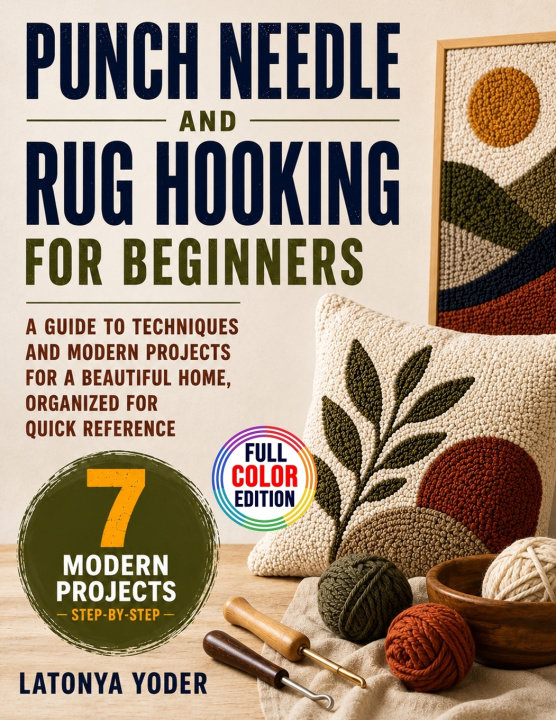
Punch Needle and Rug Hooking for Beginners
A Guide to Techniques and Modern Projects for a Beautiful Home, Organized for Quick Reference
 Inglese
 53 b
53 b
 Nuovi
Nuovi
Fino a 30 giorni per il reso

Punch Needle and Rug Hooking for Beginners teaches both crafts as one connected skill set, worked with a single small kit and a foundation stitch you can learn in an afternoon. One tool pushes loops through the backing from behind; the other pulls them through from the front. This book treats them as two halves of the same craft rather than two separate hobbies learned in isolation.
No prior experience is assumed, with punch needle, rug hooking, or fiber crafts of any kind. Every technique is taught before the project that needs it, so your hands are ready each time a new piece begins.
From first coaster to finished area rug
- Set a punch needle to an even depth and work the foundation stitch in short rows and tight spirals until the loop pile reads as one clean, continuous surface.
- Catch and pull wool strips with a traditional rug hook one warp thread at a time, holding the loops level so the woven backing never shows through.
- Choose backing with intent: monk's cloth for punch needle work, primitive-weight linen or rug warp for traditional hooking.
- Transfer and enlarge any design by the grid method, then plan a limited palette that still reads true under the light the finished piece will live in.
- Finish every raw edge with whipstitch binding so a coaster, a pillow, or a doormat lasts as long as the hours put into it.
- Correct loops that pull out, puckering, and uneven pile while they are still easy to fix, using a plain symptom-to-fix reference at the back.
The order is deliberate. Six technique chapters build tool handling, backing and fiber choice, both foundation stitches, design transfer, and color planning before a single project starts.
A drum-tight backing, a needle held perpendicular to the cloth, a hook advanced one warp thread at a time: the small mechanics that decide whether a loop holds or pulls free are spelled out and shown, not left to guesswork.
Each of the project chapters then names the technique chapters it depends on, so nothing is assumed to carry over silently from earlier in the book. Sixteen chapters in all, with a Technique Reference, a Troubleshooting Reference, and a Project Index gathered at the back for the moments a full chapter is more than the question needs.
It is built to be read two ways. Worked cover to cover, it runs in one direction, technique before project; opened mid-project for a single answer, the technique chapters double as quick lookups so a return visit never has to start over.
Seven patterns follow that arc from small to ambitious: a woven-stripe coaster set and a hooked sunburst trivet, a meadow bloom pillow, a tulip garden wall hanging, an autumn leaf doormat, a Bauhaus block area rug, and a final panel that combines punch needle and hooked textures in one piece.
The tools stay few and the first project is genuinely small, so the cost of trying is a single quiet afternoon rather than a shelf of supplies you may never touch again.
There is no wrong way to begin this, and no first piece has to be your best one. You already have the patience it asks for; everything else is waiting on these pages.


Informazioni sul libro
Inglese

Regala questo libro oggi stesso
È facile
1 Aggiungi il libro al carrello e scegli la consegna come regalo 2 Ti invieremo subito il buono 3 Il libro arriverà all'indirizzo del destinatarioCiao! Sono Libroamiko, il tuo consulente di libri.
Come posso aiutarti?