
 Contatto
 Come acquistare

Consegna
Guida all'acquisto
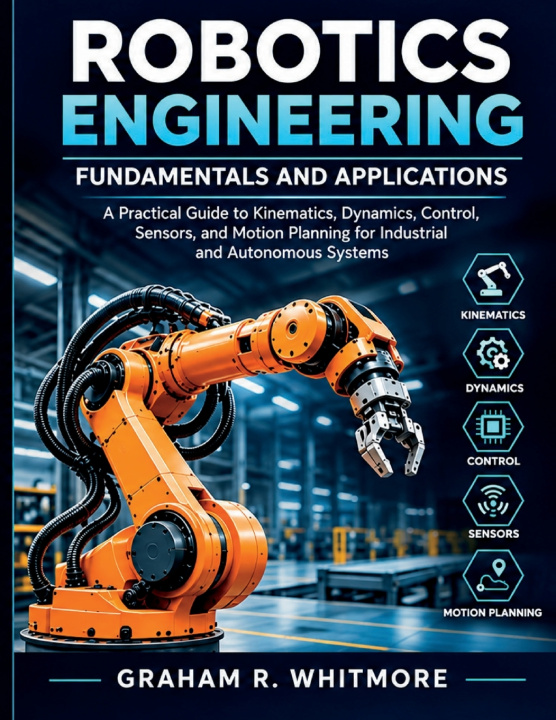
ROBOTICS ENGINEERING FUNDAMENTALS AND APPLICATIONS
A Practical Guide to Kinematics, Dynamics, Control, Sensors, and Motion Planning for Industrial and Autonomous Systems
 Inglese
 216 b
 In preparazione
 Nuovi
Fino a 30 giorni per il reso

A robot looks like a single machine, but it behaves like several cooperating systems at once: a chain of links and joints, the actuators that drive them, the sensors that report its state, and the control layer that turns intention into motion. Understand only one of those layers and you can describe a robot; you still cannot predict what the whole machine will do.
That gap is where robotics learning so often stalls. Mechanical design, electrical power, sensing, control theory, and software are usually taught apart, in separate resources with separate notation, so the mathematics stays abstract and the reader cannot actually compute where a robot's hand will be, what torque each joint must supply, or how a controller keeps the motion on course.
This book closes that gap with one coherent, quantitative path through every layer. It begins with the geometry of rigid motion and builds forward, each chapter supplying exactly what the next one needs, until the closing chapters combine every earlier idea into complete application systems. Every important relationship is derived from stated assumptions, every worked example shows its full calculation with units, and every result is checked before it is presented - so you follow not only what is true but why it is true and how it was obtained.
Inside this guide you will:
- Treat a robot as a set of cooperating subsystems, and work through position, orientation, and the forward and inverse kinematics that predict and solve a robot's pose.
- Connect joint motion to end-effector motion through velocity kinematics, and recognise the configurations where a robot loses capability.
- Follow the forces and torques of manipulator dynamics, size actuators and drive systems, and fuse sensor measurements into a reliable estimate of state.
- Design and tune feedback control, generate smooth trajectories, and plan collision-free motion for robot arms and mobile bases.
- Calibrate a camera, estimate pose from images, and apply machine vision, navigation, and control together in a working cell.
- Reinforce every chapter with learning objectives, practice problems, verified answer keys, and quick-reference appendices for day-to-day use.
It is written for upper-level undergraduate and graduate engineering students, and for practicing mechanical, electrical, control, and automation engineers moving into robotics from an adjacent field. Readers comfortable with calculus, linear algebra, and the basics of mechanics and electrical circuits will find every specialised term defined where it first appears; no prior robotics background is assumed.
Open this guide and begin building the connected, quantitative understanding of robotics that lets you reason about a complete machine with clarity and confidence.


Informazioni sul libro
Inglese

Regala questo libro oggi stesso
È facile
1 Aggiungi il libro al carrello e scegli la consegna come regalo 2 Ti invieremo subito il buono 3 Il libro arriverà all'indirizzo del destinatarioCiao! Sono Libroamiko, il tuo consulente di libri.
Come posso aiutarti?