
Entra a far parte di una comunità di amanti dei libri di tutto il mondo e ottieni numerosi vantaggi.
Crea un account gratuito
Punto Poste 5.99 €
Punto Poste 5.99 €
Poste Italiane 7.49 €
Corriere GLS 6.49 €
Punto GLS 4.99 €
Corriere Bartolini 4.99 €
Punto Bartolini 3.99 €
 Contatto
 Come acquistare

Aiuto
Consegna
Punto Poste 5.99 €
Punto Poste 5.99 €
Poste Italiane 7.49 €
Corriere GLS 6.49 €
Punto GLS 4.99 €
Corriere Bartolini 4.99 €
Punto Bartolini 3.99 €
Guida all'acquisto
Il mio account
▸
Vuoto :-(
0
Small Engine Troubleshooting For Beginners
An Illustrated Guide to Diagnosing No-Starts, Stalling and Reduced Performance in Outdoor Power Equipment
Lingua
 Inglese
Libro
In brossura
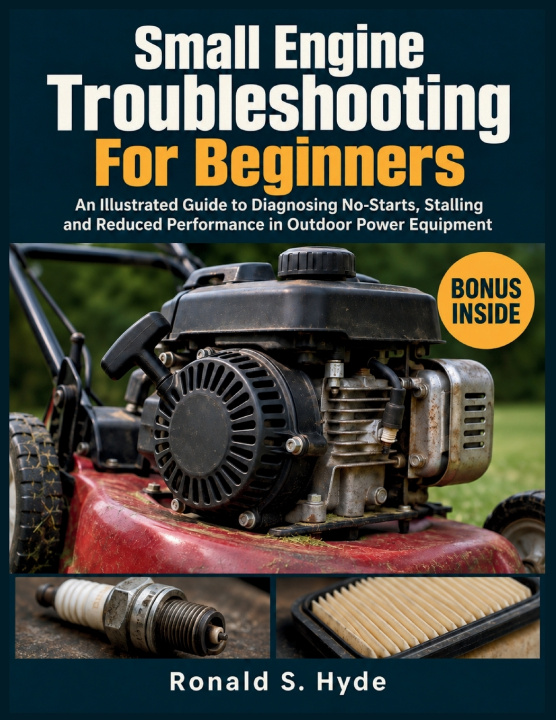
When your mower starts, sputters, and dies, what should you check first?Say you've set aside Saturda...
Descrizione completa
Codice Libristo: 54515756
?
 57 b
 In preparazione
 Nuovi
57 b
In preparazione
Nuovi
23.19
€
Immagazzinamento previsto
Pubblicazione 15. 11. 2026
Fino a 30 giorni per il reso

When your mower starts, sputters, and dies, what should you check first?
Say you've set aside Saturday morning to mow the lawn. The engine catches on the second pull, runs for a few seconds, then cuts out. It starts again after a short wait, but the moment you reach the thicker grass, it loses power. You're left wondering whether the fuel has gone stale, the air filter is clogged, or the mower is struggling under the load. Half an hour later, the lawn still needs cutting and you're no closer to knowing what happened.What would help is a clear way to connect what the machine is doing with what to check next. The order matters. A starter that won't turn the engine calls for a different first check from an engine that turns over but won't start.
Small Engine Troubleshooting for Beginners: An Illustrated Guide to Diagnosing No-Starts, Stalling, and Power Loss in Lawn Mowers and Outdoor Power Equipment teaches you to follow those clues. It starts with what you can see, hear, and record, then shows how each finding helps narrow the possible causes. It also explains which checks depend on your model's manual and when a problem calls for a technician.
Inside, you'll learn how to:
- Follow the symptom. Use decision trees to work through starting problems, stalling, uneven running, and power loss under load.
- Recognize the parts you're checking. Use photographs and diagrams to find components such as the spark plug, air filter, and fuel shutoff, and understand the roles of fuel, air, ignition, and compression.
- Record clues that matter. Use worksheets and maintenance logs to note when the engine stalls, whether it restarts after cooling, and what changed after each check.
- Apply the same reasoning to other equipment. See how troubleshooting changes for snow blowers, pressure washers, portable generators, and two-stroke tools.
If you're a homeowner or a first-time equipment owner, start with the symptom you recognize. The next time your mower fires and quits, you'll have a place to begin and a reason for the first check you make.
Attrice
&
Poliglotta
EWA KASP
per
Riproduci video


Libristo ha la più grande selezione di letteratura in lingue straniere. Per questo compro i miei libri qui.
Informazioni sul libro
Titolo completo
Small Engine Troubleshooting For Beginners
Autore
Ronald S. Hyde
Lingua
Inglese
Inglese
Rilegatura
Libro - In brossura
Data di pubblicazione
2026
Numero di pagine
208
EAN
9798141722509
Codice Libristo
54515756
Casa editrice
Independently published
Peso
495
Dimensioni
216 x 280 x 11

Regala questo libro oggi stesso
È facile
1 Aggiungi il libro al carrello e scegli la consegna come regalo 2 Ti invieremo subito il buono 3 Il libro arriverà all'indirizzo del destinatario
Consulente di libri Libroamiko
Utilizzando questa chat, stai comunicando con un'intelligenza artificiale generativa. Utilizzandola, accetti anche il trattamento dei dati personali.
Ciao! Sono Libroamiko, il tuo consulente di libri.
Come posso aiutarti?
Ciao, sono Libroamiko, posso aiutarti?