
 Contatto
 Come acquistare

Consegna
Guida all'acquisto
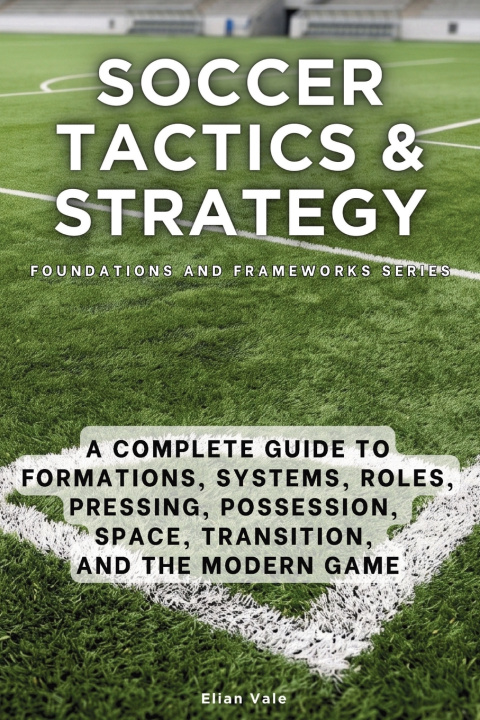
Soccer Tactics & Strategy
A Complete Guide to Formations, Systems, Roles, Pressing, Possession, Space, Transition, and the Modern Game
 Inglese
 45 b
 Nuovi
Fino a 30 giorni per il reso

Learn to read a soccer match the way coaches and analysts do. This book explains formations, player roles, pressing, and positional play in plain language, so you can see why a team wins before the scoreline tells you.
Ten chapters follow the order a coach would teach the game, starting with basic vocabulary and ending with the hybrid shapes top clubs use today.
Every idea is tied to real matches: Manchester City's 3-2-4-1 in their 2023 treble season, Leicester City's compact 4-4-2 that won the league at 5,000-1, and Arrigo Sacchi's zonal AC Milan.
You also learn why an approach works with one group of players and falls apart with another.
Chapters walk through:
- The four moments of a match, the principles of attack and defense, and how to divide the pitch into thirds, zones, and channels
- Formation notation and back-four, back-three, and narrow systems
- Why two teams in the same 4-3-3 can play nothing alike
- Player roles such as the sweeper-keeper, inverted full-back, wing-back, mezzala, regista, false nine, inside forward, and shadow striker
- Juego de posición, the five vertical lanes, half-spaces, overloads, and third-man runs
- Goal kicks, the salida lavolpiana, and the choice between playing through, around, or over a high press
- Overlaps, underlaps, cutbacks, and relationism
- Zonal and man marking, low, mid, and high blocks, and the offside trap
- Pressing triggers, cover shadows, wide and central traps, gegenpressing after losing the ball, and how PPDA measures it all
- Counterattacks after winning the ball, the rest defense a team keeps behind the ball while it attacks, and tactical fouls that stop a break before it starts
- Set-piece design, expected goals, five-substitution management, and opposition analysis
The back of the book gives you tools to keep using. A historical timeline traces the 1925 offside change, the WM, Hungary's 6-3 win at Wembley in 1953, and the ideas that answered each one.
Every chapter ends with review questions, and an Example Responses section shows what a strong answer looks like. A Key Terms and Definitions section collects words like rest defense and PPDA in one place for quick reference.
This book suits:
- Fans who want to understand what the broadcast camera leaves out
- Youth and amateur coaches, including those running 9v9 teams
- Players who want to make smarter decisions off the ball
- Aspiring analysts, writers, and students of sports coaching
You can read it straight through, since each chapter builds on the last, or turn directly to the chapter that addresses the problem in front of you, such as a team that keeps getting caught on the counter. Start with the exercise in the introduction: watch ten minutes of any match, ignore the ball, and track only the two full-backs. Finish the book, watch again, and you will know why they stand where they do and which spaces they are opening for teammates.


Informazioni sul libro
Inglese

Regala questo libro oggi stesso
È facile
1 Aggiungi il libro al carrello e scegli la consegna come regalo 2 Ti invieremo subito il buono 3 Il libro arriverà all'indirizzo del destinatarioCiao! Sono Libroamiko, il tuo consulente di libri.
Come posso aiutarti?