
 Contatto
 Come acquistare
Consegna
Guida all'acquisto
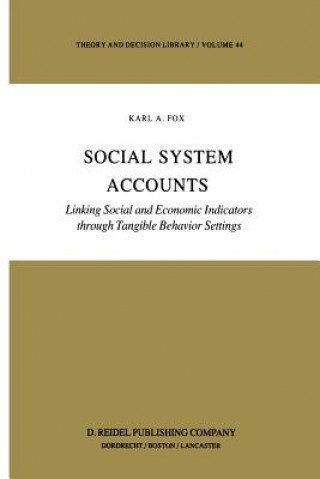
Social System Accounts
Linking Social and Economic Indicators through Tangible Behavior Settings
 Inglese
 277 b
277 b
Fino a 30 giorni per il reso
I clienti hanno acquistato anche







This book results from a research program on which I have spent most of my time since 1974. It addresses two of the major problems facing social system account ing: how to measure and account for nonmarket activities and how to combine social and economic indicators. The solution I propose is accounts based on behavior settings, a concept originated by Roger G. Barker more than thirty years ago. Behavior settings are the natural units of social activity into which people sort themselves to get on with the busi ness of daily life--grocery stores, school classes, reI i gious services, meetings, athletic events, and so on. The descriptive power of behavior settings has been established in surveys of complete communities in the United States and England, of high schools ranging in size from fewer than 100 to more than 2000 students, of rehabilitation centers in hospitals, and of several other types of organizations. Behavior settings are empirical facts of everyday life. A description of a community or an organization in terms of behavior settings corresponds to common experi ence. In many cases, small establishments are behavior settings; the paid roles in behavior settingsare occupa tions; and the buildings and equipment of establishments are the buildings and equipment of behavior settings.


Informazioni sul libro

Regala questo libro oggi stesso
È facile
1 Aggiungi il libro al carrello e scegli la consegna come regalo 2 Ti invieremo subito il buono 3 Il libro arriverà all'indirizzo del destinatarioPotrebbe interessarti anche



 /
/
 In brossura
 107.29
€
107.29
€






 /
Rigido
27.29
€
/
Rigido
27.29
€
Ciao! Sono Libroamiko, il tuo consulente di libri.
Come posso aiutarti?