
 Contatto
 Come acquistare
Consegna
Guida all'acquisto
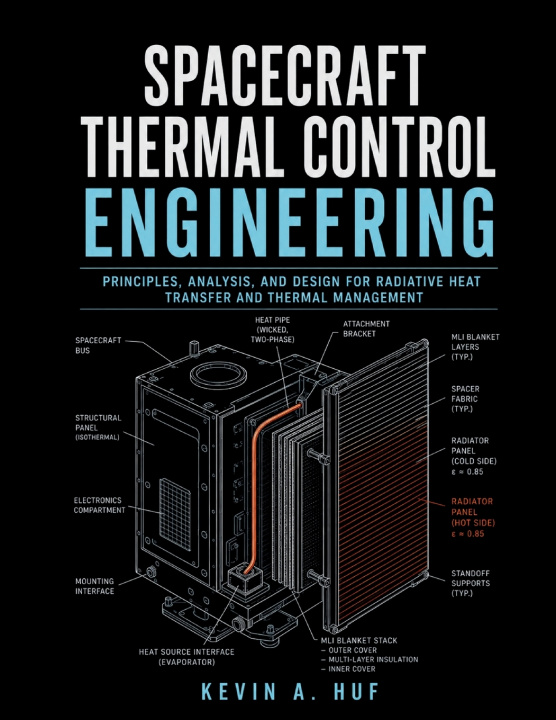
SPACECRAFT THERMAL CONTROL ENGINEERING
A Practical Guide to Radiative Heat Transfer, Materials, and Mission Design
 Inglese
 168 b
168 b
 In preparazione
 Nuovi
Nuovi
Fino a 30 giorni per il reso

Every spacecraft, from the smallest satellite to a crewed vehicle, faces an identical physical constraint: it must shed every watt it generates and absorbs using only radiation and conduction, because the vacuum of space eliminates the convective heat transfer that dominates thermal engineering on the ground. Get this wrong, and the consequences rarely announce themselves immediately. They show up instead as a sensor whose pointing quietly drifts across an orbit, a battery that loses years of capacity from months spent slightly too warm, or a radiator that underperforms because coating degradation was never fully bounded in the original design.
Many engineers first encounter this discipline as a brief unit inside a broader spacecraft systems course, a few weeks on radiative heat transfer and a passing mention of insulation blankets, with little connective tissue between the underlying physics and the hardware a working engineer actually specifies. This book closes that gap with a sustained, sequential treatment built to be read the way a real thermal design actually proceeds: from first-principles heat transfer, through the space thermal environment and the nodal modeling methods used to predict a spacecraft's temperature, to the materials, hardware, and component-level toolkit a thermal engineer relies on, and finally to how that toolkit is applied across distinctly different mission classes.
Working through this book, readers will:
Understand how heat actually moves through a spacecraft structure, using conduction resistance networks, radiative exchange between surfaces, and the solar, albedo, and planetary infrared loads that define the orbital thermal environment.
Build and interpret nodal thermal models, from steady-state networks through transient time-marching methods, while learning to recognize the modeling pitfalls that most often separate a correct design from a costly in-flight surprise.
Select and evaluate surface coatings, structural materials, and multi-layer insulation blankets, and understand how each choice shifts a component's equilibrium temperature over a mission's full lifetime.
Compare passive and active thermal hardware, including radiators, heat pipes and loop heat pipes, thermal straps, louvers, phase change materials, heaters, and pumped fluid loops, reasoning through the mass, power, and reliability trade-offs that determine which approach a given design actually needs.
Apply thermal design directly to electronics, propulsion, and power subsystems, and follow the thermal vacuum and thermal balance testing process that verifies a design against real, measured hardware behavior before flight.
See the complete toolkit applied to five distinct and demanding mission classes, CubeSats and small satellites, human spaceflight and habitats, and planetary and deep space missions, before closing with the margin and reliability philosophy that ties the entire discipline together.
Written for aerospace and mechanical engineering students, early-career thermal engineers, systems engineers who interface with the thermal subsystem, and small-satellite and CubeSat developers working with limited mass and power budgets, this guide is built to be worked through with a pencil, not merely read, with every equation fully defined and every worked example shown in complete detail.
Take the next step toward understanding and applying the principles, methods, and worked calculations covered inside, and start building a systematic, physics-first foundation in spacecraft thermal control engineering.


Informazioni sul libro
Inglese

Regala questo libro oggi stesso
È facile
1 Aggiungi il libro al carrello e scegli la consegna come regalo 2 Ti invieremo subito il buono 3 Il libro arriverà all'indirizzo del destinatarioCiao! Sono Libroamiko, il tuo consulente di libri.
Come posso aiutarti?