
 Contatto
 Come acquistare

Consegna
Guida all'acquisto
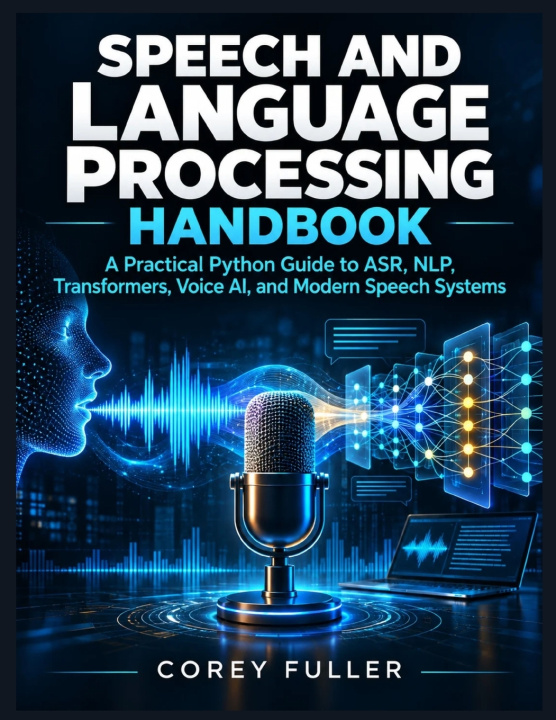
Speech and Language Processing Handbook
A Practical Python Guide to ASR, NLP, Transformers, Voice AI, and Modern Speech Systems
 Inglese
 418 b
 Nuovi
Fino a 30 giorni per il reso

Getting a speech AI model to work is one thing. Building a reliable application that performs well beyond a simple demonstration is another...
Are fragmented tutorials and outdated examples slowing down practical development?
Is it difficult to diagnose transcription errors, inconsistent outputs, or performance bottlenecks?
Does choosing between model accuracy, latency, cost, and privacy feel unnecessarily complicated?
Curey Fuller presents a structured, Python-focused reference that connects foundational principles with implementation, evaluation, and deployment. Rather than focusing on isolated demonstrations, the handbook progresses from audio processing and NLP fundamentals to transformers, large language models, speech synthesis, integrated voice AI, and a complete capstone application.
Inside the handbook, readers discover how to:
- Understand speech-processing fundamentals.
- Inspect digital audio and spectrograms.
- Build automatic speech recognition workflows.
- Prepare and process natural language.
- Explore transformers and large language models.
- Apply prompting and retrieval techniques.
- Generate natural-sounding synthetic speech.
- Design conversational voice AI systems.
- Measure word error rate and recognition quality.
- Investigate model failures systematically.
- Assess accents and noisy recordings.
- Compare accuracy, latency, and operating costs.
- Structure reproducible Python experiments.
- Protect sensitive audio and transcript data.
- Develop an end-to-end speech-enabled AI application.
Advanced AI does not have to begin with intimidating mathematics or years of speech-science experience. The material introduces essential concepts in context, connecting mathematical and linguistic ideas to practical engineering decisions. Readers with basic Python and programming or machine-learning knowledge can build their understanding progressively.
Technology also changes quickly. This handbook emphasises transferable principles, explicit configuration, reproducible experiments, meaningful evaluation, and checking current software documentation rather than assuming every model or library behaves identically. It also addresses limitations instead of promising perfect recognition or infallible AI outputs.
If you want to connect speech recognition, language models, and spoken responses, then make this handbook your next technical reference.


Informazioni sul libro
Inglese

Regala questo libro oggi stesso
È facile
1 Aggiungi il libro al carrello e scegli la consegna come regalo 2 Ti invieremo subito il buono 3 Il libro arriverà all'indirizzo del destinatarioCiao! Sono Libroamiko, il tuo consulente di libri.
Come posso aiutarti?