
 Contatto
 Come acquistare
Consegna
Guida all'acquisto
 Inglese
 26 b
26 b
 Nuovi
Nuovi
Fino a 30 giorni per il reso

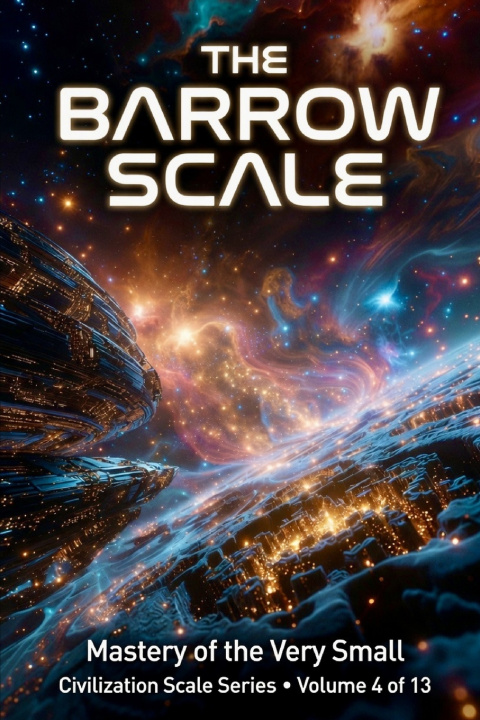
In 1998, cosmologist John D. Barrow proposed a radical alternative to the famous Kardashev Scale. While Kardashev measured civilizations by the scale of their outward power, Barrow turned the question inward. His scale runs in the opposite direction - from Type I-minus (macroscopic manipulation) down through genes, molecules, atoms, and nuclei, all the way to Type Omega-minus: the engineering of spacetime itself.
This book offers the most comprehensive exploration of the Barrow Scale available. It traces Barrow's life and intellectual development, examines the seven categories of inward mastery in detail, and assesses where humanity currently stands - spanning mature Type II-minus and Type III-minus capabilities while still struggling at the thresholds of nanotechnology and controlled nuclear engineering. Along the way, it explores Richard Feynman's foundational vision, the historic Drexler-Smalley debate over molecular manufacturing, the rise of CRISPR gene editing as a transformative Type II-minus technology, and the emerging frontier of quantum computing.
Equally important, this volume confronts the scale's limitations with honesty. The Barrow Scale excels at revealing hidden dimensions of capability, but it creates a significant detection problem for the search for extraterrestrial intelligence. Civilizations that have mastered the very small may leave almost no visible technosignatures across interstellar distances. This book examines that challenge and shows why the Barrow Scale cannot stand alone - it must be integrated with the energy, spatial, and tool-based lenses explored in the earlier volumes of this series.
Part of the Civilization Scales Series, this book continues the project of building a multi-dimensional framework for understanding civilizational advancement. It demonstrates that looking inward may be as essential as looking outward, and that the civilizations that master both directions may ultimately prove the most resilient and capable.
For readers interested in the future of technology, the philosophy of science, SETI, nanotechnology, and the deeper patterns of civilizational development.


Informazioni sul libro
Inglese

Regala questo libro oggi stesso
È facile
1 Aggiungi il libro al carrello e scegli la consegna come regalo 2 Ti invieremo subito il buono 3 Il libro arriverà all'indirizzo del destinatarioCiao! Sono Libroamiko, il tuo consulente di libri.
Come posso aiutarti?