
 Contatto
 Come acquistare
Consegna
Guida all'acquisto
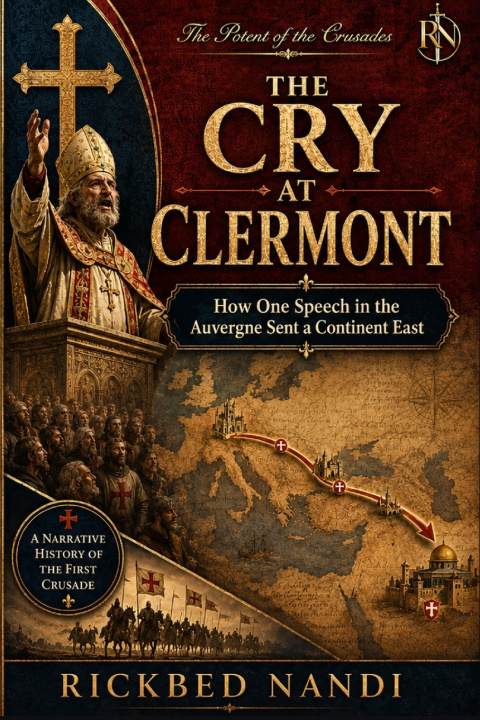
THE CRY AT CLERMONT
How One Speech in the Auvergne Sent a Continent East
 Inglese
 30 b
30 b
 Nuovi
Nuovi
Fino a 30 giorni per il reso

Preface
On an autumn day in 1095, on a field outside the small town of Clermont in the Auvergne, Pope Urban II delivered a sermon whose consequences outgrew both the crowd before him and the political world that had produced him. The words themselves were not preserved as a transcript. They reached later generations through rival memories, sermons rewritten after victory, and chronicles shaped by the needs of their authors. Yet the act of speaking mattered. It helped place a new kind of expedition within reach of the Latin Christian imagination: an armed pilgrimage to the East, promised divine favour, directed toward Jerusalem, and capable, in the minds of many who heard it, of changing the fate of the soul.
This book begins with that cry at Clermont, but it does not treat the First Crusade as the result of one voice alone. No speech, however powerful, can explain why princes, monks, knights, peasants, merchants, women, children, and whole households left their homes and moved across Europe and Anatolia toward the eastern Mediterranean. The crusade became possible because a series of older tensions had already made the ground ready. A reforming papacy had learned to speak with a new moral confidence. Western aristocratic violence had become an urgent religious problem. Byzantium had suffered catastrophic losses in Anatolia. The Seljuk world was divided by rival dynasties. The Fatimid caliphate watched events from Egypt. In every direction, the political map was fractured, and the religious imagination was alive with danger and promise.
The familiar story often reduces these events to a single opposition, Christian West against Muslim East. The reality was more difficult. Latin princes distrusted one another. The Byzantine emperor sought help, but not necessarily the independent armies that arrived at Constantinople. Muslim rulers competed with Muslim rulers, and Sunni and Shia political traditions faced one another across deep divisions. Christian communities in the eastern Mediterranean had their own histories, languages, and interests, which did not always match those of the newcomers from the West. Armenians, Syriac Christians, Greeks, Jews, Arabs, Turks, Kurds, and Franks lived through the same crisis differently. A narrative history must make room for those differences, even when the pace of events is fast.
The chapters that follow therefore move between councils and camps, churches and market roads, court politics and hunger. They follow the preaching of Urban II, the alarming force of popular enthusiasm, the slaughter of Jewish communities along the Rhine, the hard bargaining at Constantinople, the sieges of Nicaea and Antioch, and the final approach to Jerusalem. They also attend to the less celebrated conditions that decide the fate of armies: weather, animals, supply, disease, fortifications, treachery, rumours, holy relics, and the ability to persuade exhausted people that endurance still has meaning.
At the centre of this history lies a moral difficulty that cannot be removed by admiration for courage or by contempt for the past. The First Crusade created stories of sacrifice and deliverance for many of its participants. It also produced massacre, dispossession, and memories of terror that lasted long after the banners had vanished from the walls of Jerusalem. The destruction of Jewish communities in the Rhineland and the killing that followed the capture of Jerusalem must not be made incidental to a tale of triumph. They belong at the centre of any honest account, because they reveal what happens when sacred purpose joins military force and a population is turned into an enemy beyond mercy.


Informazioni sul libro
Inglese

Regala questo libro oggi stesso
È facile
1 Aggiungi il libro al carrello e scegli la consegna come regalo 2 Ti invieremo subito il buono 3 Il libro arriverà all'indirizzo del destinatarioCiao! Sono Libroamiko, il tuo consulente di libri.
Come posso aiutarti?