
 Contatto
 Come acquistare
Consegna
Guida all'acquisto
 Inglese
 64 b
64 b
 Nuovi
Nuovi
Fino a 30 giorni per il reso

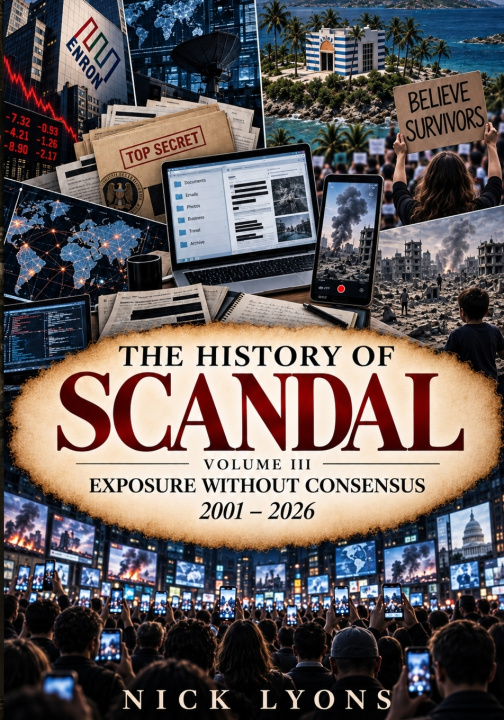
By the twenty-first century, exposure was no longer scarce. Agreement was.
The History of Scandal, Volume III: Exposure Without Consensus traces the history of scandal from 2001 through 2026, as the internet, smartphones, social media, digital archives, leaks, and networked communication transformed who could expose wrongdoing, distribute evidence, challenge institutions, and participate in public judgment. Information that once depended upon journalists, governments, courts, or broadcasters to reach a mass audience could now circulate around the world almost instantly.
From 9/11, the Iraq WMD scandal, and Abu Ghraib to WikiLeaks, Edward Snowden, the Panama Papers, #MeToo, Jeffrey Epstein, COVID-19, January 6, and Gaza, the scandals of the new century unfolded within an unprecedented abundance of evidence. Photographs, videos, emails, databases, leaked documents, private messages, satellite imagery, and millions of pages of official records could expose conduct once hidden from public view. But visibility did not guarantee understanding, and more evidence did not necessarily produce greater agreement.
Institutions that had spent the twentieth century establishing public facts increasingly found themselves subjected to the same scrutiny they applied to others. Investigations could be reconstructed, experts challenged, official claims compared with their underlying evidence, and corrections examined for what they still omitted. At the same time, ordinary people gained extraordinary powers to document their own experiences, find others who shared them, and transform what appeared to be private misfortune into evidence of public wrong.
The result was not a world in which truth ceased to matter, but one in which exposure, verification, and consensus increasingly became separate problems. Authentic evidence could be misunderstood. Institutional failure could justify skepticism without proving every alternative explanation. A conclusion could be strongly established without becoming commonly accepted. The machinery of public knowledge had become more powerful and more distributed than ever before, even as the authority to settle public judgment became increasingly contested.
Exposure Without Consensus completes The History of Scandal, a three-volume global history of the changing boundaries between private behavior, public knowledge, and public judgment.


Informazioni sul libro
Inglese

Regala questo libro oggi stesso
È facile
1 Aggiungi il libro al carrello e scegli la consegna come regalo 2 Ti invieremo subito il buono 3 Il libro arriverà all'indirizzo del destinatarioCiao! Sono Libroamiko, il tuo consulente di libri.
Come posso aiutarti?