
 Contatto
 Come acquistare
Consegna
Guida all'acquisto
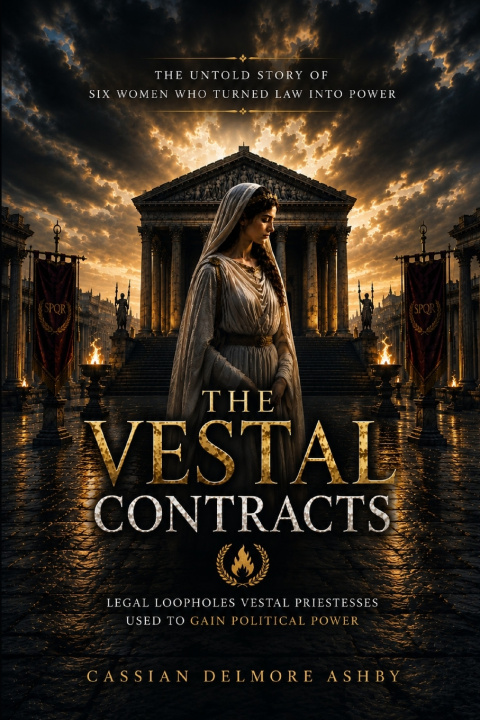
THE VESTAL CONTRACTS
Legal Loopholes Vestal Priestesses Used to Gain Political Power
 Inglese
 40 b
40 b
 Nuovi
Nuovi
Fino a 30 giorni per il reso

Six women. Thirty years. A single flame that could not be allowed to die. And a loophole that some of the most powerful families in Rome quietly turned into one of the greatest legal advantages in the ancient world.
Everyone knows the Vestal priestesses kept Rome's sacred fire burning. Almost no one knows what burning that fire actually bought them. The moment a girl entered the College of Vestals, something remarkable and almost accidental happened to her under Roman law. She stopped needing a guardian's permission to buy land. She could write a will no man could challenge. She could testify in court without swearing an oath, and the court believed her anyway. She walked the streets behind a lictor, the same escort that cleared the path for consuls. And if she happened to cross paths with a condemned man on his way to execution, the law said she could set him free with a word.
Rome's oldest families understood exactly what this meant. This book follows them as they used it: the orator who defended a Vestal accused alongside Rome's richest man, because the real prize was her villa, not her virtue. The tribune who overturned a pontifical acquittal and sent three priestesses to a slow death in an underground chamber near the Colline Gate. The sister in law of Cicero's own wife, tried beside a man who would later try to burn the Republic down. The Vestals who quietly held the wills of Julius Caesar and Mark Antony, and the day Octavian tore one of those wills out of their hands to win a war of propaganda that would decide who ruled the known world.
This is not a dry legal treatise and not a simplified retelling of things you already know about ancient Rome. It is a fast moving, character driven account of six women who were simultaneously the most controlled and the most legally free people in the Roman world, and of the families, senators, and future emperors who learned to use that contradiction for money, protection, and raw political power. Every case in these pages comes from real Roman sources, Livy, Plutarch, Suetonius, Cicero, and the Roman jurists themselves, brought together into a single, propulsive narrative that reads like the political thriller it actually was.
You will meet Postumia, rebuked for dressing too elegantly. You will meet Crassus, patient enough to risk a capital charge for a piece of real estate. You will meet the Pontifex Maximus lowering his own authority in the street for a girl not yet out of her teens, and the Christian emperor who, four centuries later, finally let the fire go out for good.
If you have ever wondered how a legal system built to control women ended up creating six of the freest women in the ancient world, and what happens when the powerful discover an exception like that still on the books, this book will not let you put it down. Read it in an afternoon. You will not want to stop halfway.


Informazioni sul libro
Inglese

Regala questo libro oggi stesso
È facile
1 Aggiungi il libro al carrello e scegli la consegna come regalo 2 Ti invieremo subito il buono 3 Il libro arriverà all'indirizzo del destinatarioCiao! Sono Libroamiko, il tuo consulente di libri.
Come posso aiutarti?