
 Contatto
 Come acquistare
Consegna
Guida all'acquisto
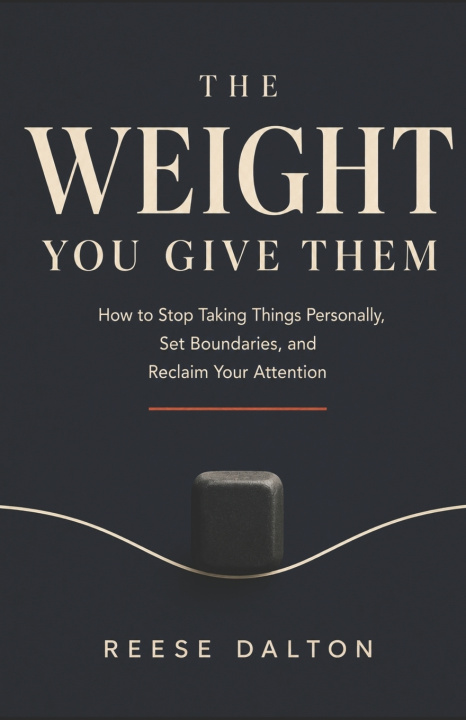
The Weight You Give Them
How to Stop Taking Things Personally, Set Boundaries, and Reclaim Your Attention
 Inglese
 32 b
32 b
 Nuovi
Nuovi
Fino a 30 giorni per il reso

A short message arrives. Four words. No explanation.
You read it again. The work in front of you slows down. By dinner, you are still trying to decide what the silence, tone, or disappointment means-and whether you are supposed to do something about it.
Other people's reactions can matter. A friend's disappointment may tell you that you broke a promise. A manager's criticism may reveal a real weakness. A partner's anger may signal something worth discussing. The difficult part is knowing what the reaction actually tells you, how much weight to give it, and what belongs to you.
The Weight You Give Them develops a practical way to make that judgment. It traces the Weight Cycle: how an event becomes an interpretation, captures attention, changes behavior, and creates consequences. It then turns that understanding into a five-step method: SEE-SORT-OWN-CHOOSE-RETURN.
SEE the moment your attention shifts.
SORT fact from inference, fear, and what remains unknown.
OWN what is yours, what belongs to someone else, what is shared, and what cannot yet be assigned.
CHOOSE the response the situation actually calls for-asking, clarifying, repairing, setting a boundary, negotiating, leaving, or doing nothing.
RETURN when the useful work is complete.
Drawing on research on rejection sensitivity, rumination, uncertainty, emotion regulation, social evaluation, and interpersonal judgment, the book presents this framework as a research-informed practical synthesis rather than a clinical treatment protocol. Worked examples show how it applies to delayed replies, criticism, family pressure, disappointment, anger, difficult conversations, approval, and the conversations you keep replaying after they are over.
A dedicated Practice Toolkit gives you reusable pages for the moments when thinking has started to outrun the evidence, including the Weight Cycle Map, SORT Sheet, Responsibility Map, Response Selector, Weight Test, Approval Test, One-Page Reset, Grounding Card, and Thirty-Day Maintenance practice.
Sometimes the right response is a repair. Sometimes it is a question, a boundary, or a change in behavior. Sometimes nothing further needs to happen; the situation is finished even though the feeling has not caught up yet. The skill is learning to tell those situations apart.
You can care about people without making their reactions the measure of your judgment. You can listen without handing over the decision. And you can finish the conversation without carrying it through the rest of the day.


Informazioni sul libro
Inglese

Regala questo libro oggi stesso
È facile
1 Aggiungi il libro al carrello e scegli la consegna come regalo 2 Ti invieremo subito il buono 3 Il libro arriverà all'indirizzo del destinatarioCiao! Sono Libroamiko, il tuo consulente di libri.
Come posso aiutarti?