
 Contatto
 Come acquistare
Consegna
Guida all'acquisto
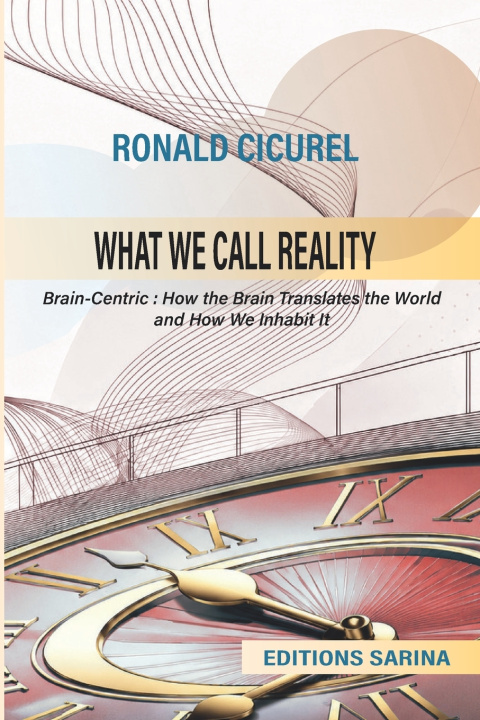
WHAT WE CALL REALITY
Brain-Centric: How the Brain Translates the World and How We Inhabit It
 Inglese
 60 b
60 b
 In preparazione
 Nuovi
Nuovi
Fino a 30 giorni per il reso

At a time when artificial intelligence compels us to rethink the very nature of intelligence, perception, and knowledge, Ronald Cicurel's What We Call Reality offers a rigorous and original framework for doing so.
Cicurel, a mathematician and philosopher, introduces Brain-Centric, a shift in perspective that places the brain not merely as an object of scientific study, but as the active translator through which all study becomes possible. Between the continuous, unfragmented order of what is, and the discrete, habitable world we call reality, stands the neural membrane: a biological analog-to-digital converter that selects, cuts, stabilizes, and silently forgets its own operation.
The book draws on a broad intellectual genealogy. From David Bohm, it takes the distinction between implicate and explicate order. From Alfred Korzybski, it inherits the warning that the map is not the territory, together with the critique of primitive and multi-ordinal terms. From Niels Bohr, it retains the lesson that quantum measurement cannot be separated from the conditions of observation. From Miguel Nicolelis, it takes the theory of the relativistic brain and the experimental possibility of coupled neural systems, the Brainnet. Brain-Centric integrates these threads into a single operative framework.
The central thesis is that what we call reality is not given; it is co-produced. The brain performs a double movement that Cicurel names the FGDS (Forced Generalization of Dissociated Structures): it fragments the continuous flux, then reassembles the fragments into a coherent world. Without this operation, no perception, no science, no language is possible. But when the operation forgets itself, when the map is taken for the territory, the same mechanism becomes a source of closure, confusion, and domination.
The book examines the consequences across several domains. In quantum physics, it reads indeterminacy and non-locality not as mysteries of nature, but as signatures of the translation threshold. In mathematics, it follows Gödelian incompleteness as the trace of a system that cannot totalize its own conditions of production. In linguistics and philosophy, it analyzes how words such as information, energy, consciousness, the market, and artificial intelligence become liminal artifacts: concepts that function so well they end up replacing what they were meant to describe. In the contemporary digital economy, it shows how attention, when industrially captured and algorithmically distributed, becomes a form of collective reality-formation.
What We Call Reality is not a critique of science. It is an invitation to a more lucid science, one that includes the conditions of its own production in what it can say. It is written for philosophers, scientists, mathematicians, cognitive researchers, and any reader who, in an age of artificial intelligence, feels the urgency of understanding how the mind makes the world thinkable, and what is lost in the making.


Informazioni sul libro
Inglese

Regala questo libro oggi stesso
È facile
1 Aggiungi il libro al carrello e scegli la consegna come regalo 2 Ti invieremo subito il buono 3 Il libro arriverà all'indirizzo del destinatarioCiao! Sono Libroamiko, il tuo consulente di libri.
Come posso aiutarti?