
 Contatto
 Come acquistare
Consegna
Guida all'acquisto
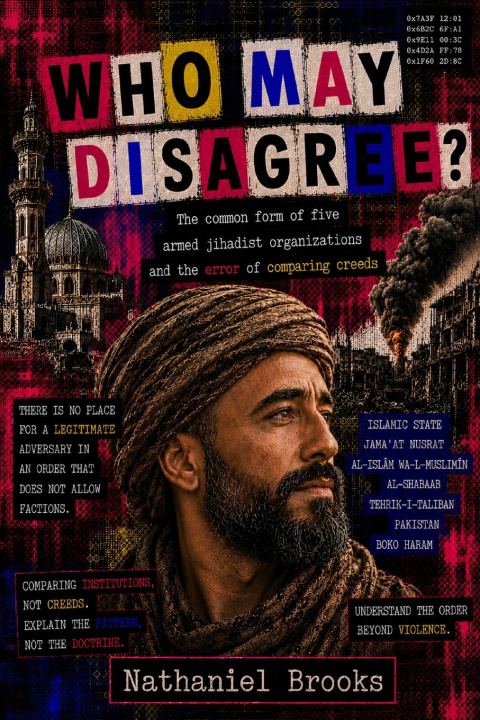
WHO MAY DISAGREE?
The common form of five armed jihadist organizations and the error of comparing creeds
 Inglese
 42 b
42 b
 In preparazione
 Nuovi
Nuovi
Fino a 30 giorni per il reso

The Common Form of Five Armed Jihadist Organizations and the Error of Comparing Creeds
Why do armed organizations separated by continents, languages, legal traditions, and religious lineages repeatedly construct remarkably similar political orders?
Who May Disagree? offers a new answer to one of the central questions in comparative political science. Rejecting the widespread assumption that institutional behavior derives directly from religious doctrine, Nathaniel Brooks argues that what unites the Islamic State (ISIS), JNIM, al-Shabaab, Tehrik-i-Taliban Pakistan, and the two Boko Haram successor organizations is not ideology itself, but a shared institutional architecture.
Through a comparative analysis grounded in political theory, rebel governance, institutional sociology, and contemporary research on armed organizations, the book demonstrates that these movements converge on a common political form: an order that contains no legitimate position for the political dissenter.
Rather than comparing creeds, Brooks compares institutions-courts, taxation systems, mechanisms of exclusion, legal authority, administrative structures, and the procedural treatment of disagreement. The result is a new theoretical framework capable of explaining similarities that prevailing ideological explanations leave unresolved.
Drawing on extensive contemporary scholarship and a rigorously comparative methodology, Who May Disagree? contributes to debates on political order, authoritarianism, insurgency, institutional design, political violence, and comparative political theory. This is not a book about terrorism alone. It is a book about the architecture of political power.


Informazioni sul libro
Inglese

Regala questo libro oggi stesso
È facile
1 Aggiungi il libro al carrello e scegli la consegna come regalo 2 Ti invieremo subito il buono 3 Il libro arriverà all'indirizzo del destinatarioCiao! Sono Libroamiko, il tuo consulente di libri.
Come posso aiutarti?