
 Contatto
 Come acquistare
Consegna
Guida all'acquisto
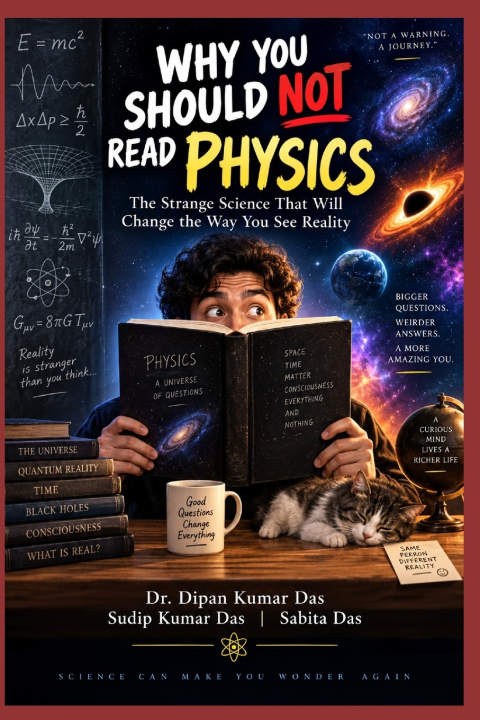
WHY YOU SHOULD NOT READ PHYSICS
The Strange Science That Will Change the Way You See Reality
 Inglese
 27 b
27 b
 Nuovi
Nuovi
Fino a 30 giorni per il reso

Chapter 1: The Day Reality Stops Making Sense
Physics begins innocently enough. We learn that objects fall, clocks tick, light travels, and matter occupies space. These ideas seem so obvious that we rarely question them. Then physics starts asking dangerous questions.
Chapter 2: Time Is Not What You ThinkWe live as though time were a universal river flowing at exactly the same speed everywhere. It isn't. Einstein's theory of relativity revealed that time depends on motion and gravity. Two people can experience different amounts of elapsed time while following different paths through spacetime. The chapter takes the reader on a journey from ordinary clocks to atomic clocks, high-speed spacecraft, gravitational time dilation, and the astonishing fact that relativity is not merely philosophical. It is essential to technologies such as GPS.
Chapter 3: Nothing Is EmptyTake a vacuum. It looks like nothing. Physics disagrees. Quantum theory tells us that what we casually call empty space possesses physical structure. Quantum fields permeate space, and what we perceive as particles can be understood as excitations of those fields. The reader learns that "nothing" is a surprisingly complicated concept.
Even more disturbing is the realization that the solid world around us is largely empty space. Atoms contain enormous regions where there is no ordinary matter.
The chair beneath you feels solid, yet its solidity emerges from interactions between quantum structures.
Reality, it turns out, is not built quite the way our senses suggest.
Chapter 4: The Universe Does Not Follow Common SenseQuantum mechanics may be the strongest reason to avoid reading physics. At microscopic scales, nature behaves in ways that resist everyday intuition. Electrons can interfere like waves.
Chapter 5: You Are Mostly Empty SpaceLook at your hand. It appears solid. Now zoom in. Atoms. Zoom in again. Nuclei and electrons. Zoom further. Quarks, fields, interactions, and quantum structure.
Chapter 6: Gravity Is Not a Force the Way You LearnedNewton gave humanity an extraordinarily successful description of gravity. Then Einstein changed the question. Instead of imagining gravity simply as a force pulling objects together, general relativity describes gravity through the geometry of spacetime.
Chapter 7: Black Holes Are Not Really HolesThe name is misleading.
A black hole is not a hole punched through space.
It is an extreme gravitational object whose defining boundary, the event horizon, marks a region from which signals cannot escape to distant observers.
This chapter takes the reader inside the physics of black holes.
Chapter 8: The Universe Is Stranger Than the Universe We Can SeeFor centuries, humans imagined the visible stars and planets as essentially everything. Modern cosmology shattered that assumption.
Chapter 9: The Arrow of Time and the Mystery of EntropyPhysics contains a peculiar contradiction.
Many fundamental physical laws work almost equally well forward or backward in time.
Yet our lives clearly do not.
A glass can fall and shatter.
The shattered pieces do not spontaneously leap upward and reconstruct the glass.
We remember yesterday, not tomorrow.
Stars form, evolve, and die.
Chapter 10: Is Reality Computable, Random, or Something Else?After quantum mechanics, relativity, cosmology, and thermodynamics, physics reaches a philosophical frontier.
What exactly is reality?
Is the universe fundamentally deterministic?
Does quantum mechanics introduce genuine randomness?
Could the universe be described completely by mathematical laws?
Could spacetime itself be emergent?
Chapter 11: The Real Reason You Should Not Read Physics

Informazioni sul libro
Inglese

Regala questo libro oggi stesso
È facile
1 Aggiungi il libro al carrello e scegli la consegna come regalo 2 Ti invieremo subito il buono 3 Il libro arriverà all'indirizzo del destinatarioCiao! Sono Libroamiko, il tuo consulente di libri.
Come posso aiutarti?