 Contatto
 Come acquistare
Consegna
Guida all'acquisto
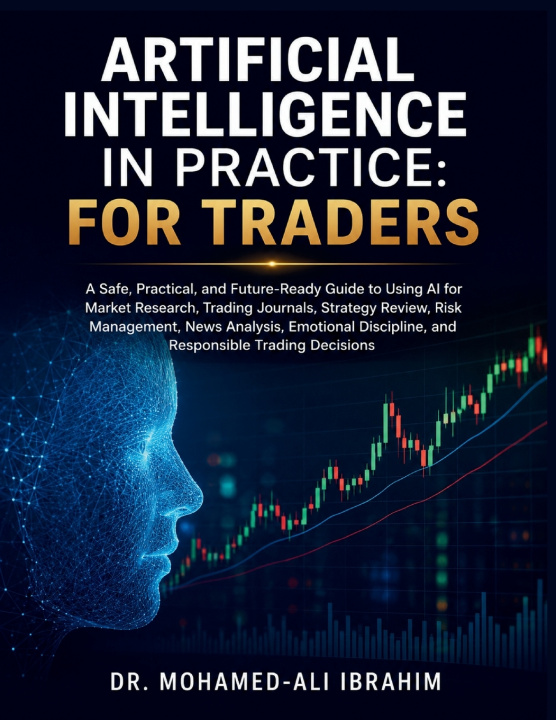
Artificial Intelligence in Practice
A Safe, Practical, and Future-Ready Guide to Using AI for Market Research, Trading Journals, Strategy Review, Risk Management, News Analysis, Emotional Discipline, and Responsible Trading Decisions
 Inglese
 144 b
144 b
 In preparazione
 Nuovi
Nuovi
Fino a 30 giorni per il reso
I clienti hanno acquistato anche



Artificial Intelligence in Practice: For Traders
A Safe, Practical, and Future-Ready Guide to Using AI for Market Research, Trading Journals, Strategy Review, Risk Management, News Analysis, Emotional Discipline, and Responsible Trading Decisions
Introduction
Artificial intelligence is rapidly changing how traders access information, review financial news, organise market research, study strategies, maintain trading journals, and evaluate their own decision-making.
But AI does not remove market uncertainty.
It cannot guarantee profits, predict every price movement, control emotions, protect capital automatically, or replace a disciplined trading plan.
Artificial Intelligence in Practice: For Traders is a practical, beginner-friendly guide for traders who want to use AI for learning, preparation, research, journaling, risk awareness, and performance review-without treating it as a financial adviser, signal provider, or guaranteed profit system.
Trading can be exciting, but it can also be stressful, emotional, confusing, and financially risky. Traders are surrounded by charts, indicators, economic events, market headlines, social media opinions, automated tools, trading communities, and promises of effortless returns.
This book helps readers separate responsible AI support from dangerous shortcuts.
You will learn how to use AI to organise non-sensitive market notes, summarise news carefully, create pre-trade and post-trade checklists, improve trading journals, review emotional patterns, clarify strategy rules, build learning plans, recognise scams, and strengthen trading discipline.
The book also explains how to protect brokerage information, passwords, API keys, wallet seed phrases, private financial data, and account security. It teaches traders to verify important information, avoid false certainty, control leverage, recognise emotional trading, and involve qualified professionals when decisions concern serious money, tax, legal, regulatory, or security matters.
With practical prompts, exercises, journal templates, risk checklists, case studies, workbook pages, an AI impact dashboard, and a structured six-week practice plan, this guide helps traders build safer and more disciplined AI-supported routines while keeping human judgement and personal responsibility in control.
Main Benefits of the Book
Readers will learn how to:
- Use AI to organise market research without requesting trading signals.
- Summarise financial news while identifying uncertainty and information requiring verification.
- Create structured trading-journal templates.
- Review completed trades for discipline, emotions, risk mistakes, and rule-breaking.
- Identify repeated patterns such as overtrading, revenge trading, fear of missing out, and moving stop losses.
- Build practical pre-trade and post-trade checklists.
- Review trading strategies for missing or unclear rules.
- Create responsible risk-management reminders.
- Understand concepts such as leverage, drawdown, volatility, position sizing, liquidity, and risk-reward ratios.
- Develop stronger emotional discipline and stop-trading rules.
- Use AI to challenge trade ideas rather than confirm emotional decisions.
- Avoid prediction traps, false certainty, and guaranteed-profit claims.
- Recognise scam language used by fake experts, signal sellers, and questionable AI trading platforms.
- Protect broker credentials, passwords, API keys, wallet information, and financial data.
- Write safer and more effective AI prompts for trading-related tasks.


Informazioni sul libro
Inglese